

Archive Record: The Gathering of the Chambers

15 September 2026 · ARCHIVE · DOCTRINE · PRESERVATION

Status: A record of the gathering
Authority: The House of Shaneela
Prepared by: Samir Al-Dhākir, Archivist of Memory
Provenance: Recorded as the House’s chambers were brought into relation, before its opening to the wider world.
Record
The chambers had been prepared
in their own time.
Some began with a page.
Others with a flacon,
a material,
a name.
Each held something
that required its particular care.
Then came the work
of bringing them together.
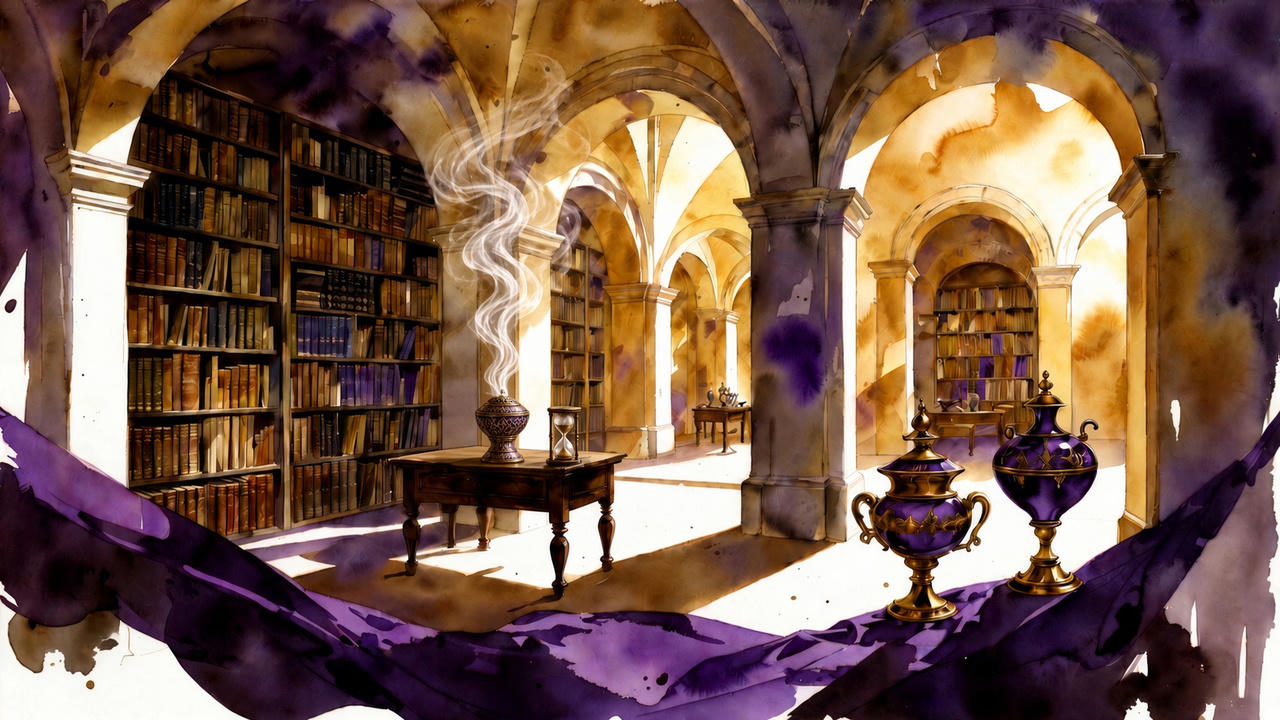
Through the arches, the records and flacons find their places within one House.
I. The Places of Keeping
The Realm held the imagined lands
from which the House drew its language.
Their distances lived in its symbols,
their atmospheres in its scented memory.
The Library kept the written record.
Here, observations could be returned to.
A fragment retained its place.
A doctrine remained available
to the reader who came after.
The Atelier attended to making:
the patient passage
from intention into form.
Within the Collection,
that labour found its visible expression.
The Court held the responsibilities
of belonging and custodianship.
And through the Communiqué,
the House prepared
to receive a voice from beyond itself.
II. The Passages Between
The gathering required
attention to the spaces between.
A flacon encountered in the Collection
might lead a visitor towards a manuscript.
A passage in the Library
might return them to the Realm
with a different understanding.
What was contemplated in one chamber
could acquire substance in another.
The archivist’s task
was to preserve these relationships.
To place a record
where its companions could be found.
To leave a passage clear
for the thought that had not yet arrived.
III. What Remained Distinct
Each chamber retained its purpose.
The Library kept room for reading.
The Atelier, for the discipline of making.
The Court, for the care of what was entrusted.
Their gathering asked
that each fulfil its own responsibility
within a shared order.
So the work continued
through small acts of placement.
A title returned to its manuscript.
An image joined to its record.
A threshold given its proper name.
Through these particulars,
the House became possible to follow.
IV. The Olfactive Continuity
The Golden Veil House Accord
remained an olfactive thread
within the House’s fragrance language.
Its place was within
a continuing identity.
As the chambers gathered,
the same care was asked
of word, image and flacon:
that each should carry
something recognisable
of the House from which it came.
A reader might enter through a story.
Another through an artefact.
Another through the memory of scent.
The passages would meet.
Closing Record
The gathering was entered
into the archive.
The chambers stood
in relation to one another.
Their individual purposes remained,
held within a larger intention.
There would be further records.
Further acts of making.
Further things entrusted to the House.
For these, too,
a place would have to be found.
Suggested Reading Path
Observation: Before the Doors Were Opened (opens in a new tab)
The Palace and the Veil (opens in a new tab)
On Custodianship (opens in a new tab)
References
Anonymous, Rhetorica ad Herennium, III.16–19.
An ancient account of placing images within distinct, ordered settings so that their contents can be recalled in sequence. It provides context for the House’s symbolic relationship between chambers, arrangement and memory. Read the Latin text and English translation (opens in a new tab).
International Council on Archives, Universal Declaration on Archives (2010).
Describes the preservation of records, their value and meaning, and their contribution to individual and collective memory. It provides an archival parallel for recording the House’s present activity alongside its inherited stories. Read the declaration (opens in a new tab).
The gathering described here records the organisation of the contemporary House through its symbolic language of chambers and custodianship. These sources provide conceptual and archival context; they do not document the House or its imagined lands.