


Doctrine: The Encoded Elixir as Marker of Lineage

26 February 2026 · DOCTRINE · PERFUMERY · PRESERVATION · SYMBOLISM

Status: Preserved
Author: Cleopatra VII
Recorded By: Royal Scribe of the Eastern Expedition
Provenance: A doctrinal leaf within the House’s imagined archive, attributed to Cleopatra VII and set in Alexandria in the first century BCE, following her return from Arachosia and the entrustment of the Encoded Elixir to the Line of Joseph.
House Fragment — Koine Greek
οὐκ ἔστιν κόσμος,
ἀλλὰ σημεῖον.
οὐκ ἔστιν τέρψις,
ἀλλὰ γνῶσις.
ouk estin kosmos,
alla sēmeion.
ouk estin terpsis,
alla gnōsis.
It is not adornment,
but a sign.
It is not pleasure,
but knowledge.
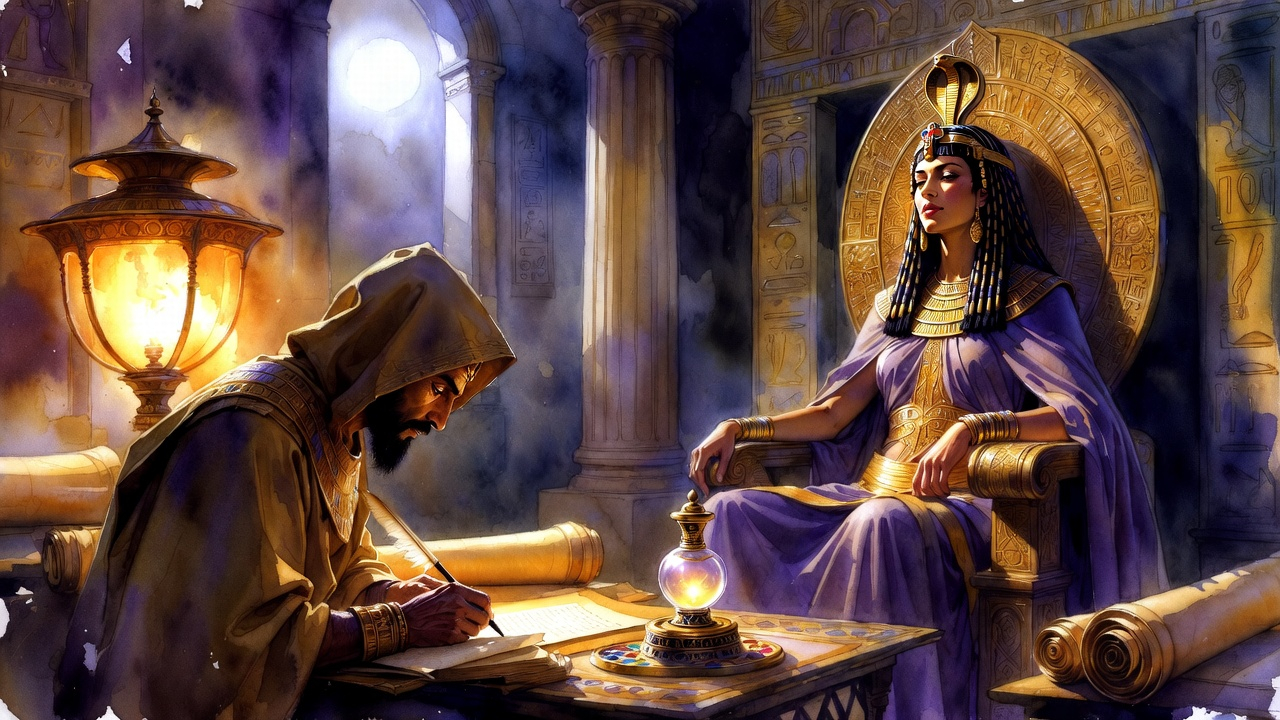
What is preserved is not ornament, but sign.
Continuation
The covenant was sealed beyond the walls
of Alexandria of Arachosia.
This leaf does not repeat its terms.
It records why the composition
must remain unchanged.
The Encoded Elixir is not kept for adornment. Its fragrance is not the end of its purpose. What was prepared, sealed and entrusted carries the continuity of a trust now placed beyond Egypt, yet bound to it.
It is preserved for recognition.
Words may be repeated.
Claims may be spoken.
Names may be taken.
The composition is to remain
when these no longer suffice.
Within its keeping rests the distinction between the true line and its imitation. What has been entrusted must not be remade to answer a claim. The claim must answer to what has been preserved.
Where the elixir is found in truth,
the line is confirmed.
Where it is absent, altered or counterfeited,
the claim is broken.
For this reason, no receiving hand may diminish it. No custodian may reform it. No one entrusted with its passage may confuse its purpose with display.
The charge is not merely
to keep a fragrance.
It is to keep the sign
by which recognition remains possible.
When memory falters, when names are concealed, and when blood alone is not enough to speak, the composition shall retain its witness.
The Encoded Elixir does not create the line.
It reveals it.
✧
References
Aristotle, Poetics, chapter XVI.
Examines recognition through signs, external tokens and memory in poetry. A literary context for the distinction between a spoken claim and a sign of identity. Read the work (opens in a new tab).
Theophrastus, Concerning Odours, §§38–41.
On the differing endurance of perfumes and the care required to preserve their character. Read the work (opens in a new tab).
Companion record within the House archive:
Royal Record: The Arachosian Covenant of Custodianship. The covenant whose charge this doctrinal leaf interprets. Read the companion manuscript (opens in a new tab).
The external works provide literary and material context. They do not attest to Cleopatra’s imagined expedition or establish that fragrance can authenticate ancestry or remain unchanged across generations. Those properties belong to the fictional Encoded Elixir within the House archive.