
Distillation Record: What the Flower Releases
10 November 2026 · PERFUMERY · PRESERVATION · OBSERVATION

Status: Prepared for the House archive
Authority: The House of Shaneela
Prepared by: Samir Al-Dhākir, Archivist of Memory
Provenance: A contemporary record concerning medieval perfume literature and the continuing practice of floral distillation.
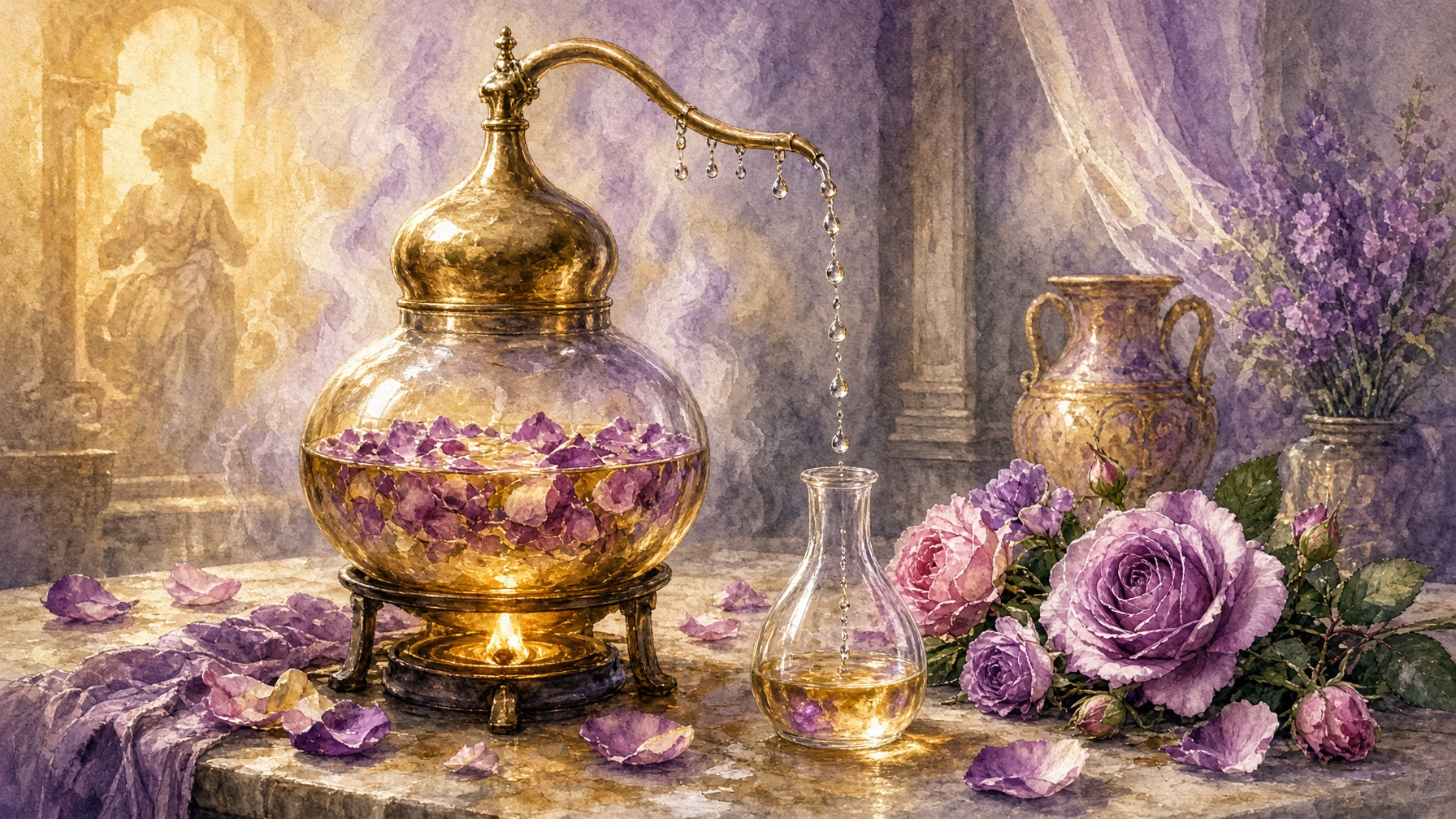
Petals, water and the patient gathering of scent.
Record
I. The Written Craft
Among the writings associated
with the ninth-century thinker al-Kindi
is the Book of the Chemistry
of Perfume and Distillations.
It preserves knowledge
of perfume making
and the treatment of aromatic materials.
Distillation belongs
within that record.
The flower enters the written tradition
through the work performed upon it:
the preparation,
the heating,
the collection of what rises
and returns as liquid.
A fleeting fragrance
becomes a matter
of sustained attention.
II. Water Bearing Scent
The perfumers and distillers
of the medieval Islamic world
worked within a broad culture
of aromatic knowledge.
Rose water was among its preparations.
The text associated with al-Kindi
records floral distillation;
scholarship examining it
has considered its directions
for preparing rose water.
Behind the written account
stands the practical encounter:
plant material,
water,
heat,
and the apparatus
through which vapour is gathered
and cooled.
The collected water
bears something of the flower.
Its scent has passed
through a process.
III. The Continuing Practice
In Taif,
roses are still gathered
and taken for distillation.
UNESCO records the transmission
of these practices within families:
children learning through observation,
participation,
and work beside their elders.
Rose water and rose oil
continue into fragrance,
hospitality
and daily life.
The inheritance encompasses
many makers, places and centuries.
Written knowledge survives
alongside knowledge
carried in the hands.
IV. The House’s Reflection
The House gives this passage
its own words:
Over the alembic,
petals do not surrender
their scent at once.
Under heat,
in the presence of water,
they release
what they would not give freely,
a little at a time.
There is patience
in the receiving.
Attention to what rises.
Attention to what returns.
A flacon may hold
the finished water.
The work that brought it there
extends beyond its glass.
Closing Record
Remember the writer
who set knowledge into words.
Remember the distiller
who learned through practice.
Remember the hands
that carried the craft
into another season.
Every drop of rose water
carries a little
of that inheritance.
References
Al-Kindi, Book of the Chemistry of Perfume and Distillations, translated and edited by Karl Garbers, 1948.
The CiNii catalogue record (opens in a new tab) identifies the work, its attribution and the original edition.
Takatomo Inoue, “Al-Kindi’s Attack on Alchemy and His Perfume Making,” Orient 52 (2017), pp. 72–92.
Examines distillation in the perfume-making text associated with al-Kindi. Read the study (opens in a new tab).
UNESCO, “Cultural practices related to Taif roses.”
Documents contemporary rose cultivation, distillation and transmission within families. Read the heritage record (opens in a new tab).
The passage concerning the petals is the House’s own reflection. It is not a quotation from al-Kindi.