


Unsealed Fragment: On the Contradiction of the Threshold

7 January 2026 · archive · ancient text · preservation

Status: Unsealed
Author: Cleopatra VII
Recorded by: Unattributed Hand of the Inner Chamber
Provenance: Within the House’s imagined archive, attributed to a private record of Cleopatra VII in Alexandria, late first century BCE. Not intended for circulation.
This fragment appears within the fictional record as a reflection set down outside formal instruction. Portions remain uncertain.
House Fragment: Koine Greek
Οὐκ ἔστιν ὃ ἐκάλεσα.
Οὐδὲ τῶν ὀνομάτων
ἃ ἐδόθη μοι.
Ἦν… καὶ οὐκ ἦν
ὡς τὰ εἰωθότα.
Καὶ ὅμως,
ἐκυβέρνησε τὸ πέρας.
Ouk estin ho ekalesa.
Oude tōn onomatōn
ha edothē moi.
Ēn… kai ouk ēn
hōs ta eiōthota.
Kai homōs,
ekybernēse to peras.
It is not what I called upon.
Nor does it belong to the names
that were given to me.
It was… and was not
like familiar things.
And yet,
it governed the boundary.
Transmission Note
The Greek fragment and its English continuation are House compositions. Their attribution to Cleopatra belongs to the fiction, not to an authenticated ancient manuscript.
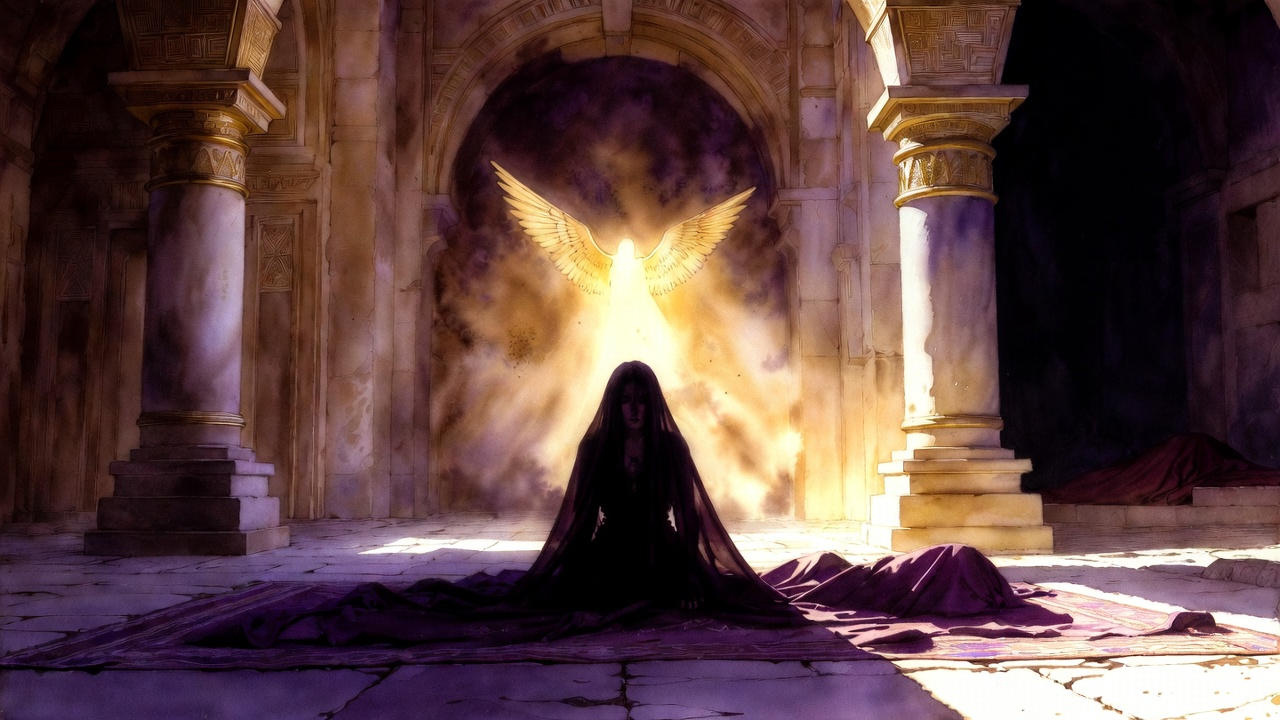
What was known… no longer held.
Continuation
What I witnessed
did not align
with what I had been taught to recognise.
It did not bear the form
of those whose names I had invoked.
Nor did it answer
to the order I had believed governed the threshold.
I called upon what was known.
What answered
was not of it.
There was no resemblance.
No symbol I had been given
could contain it.
And yet,
it was not chaos.
It did not arrive in disorder,
nor in deception.
It carried
a clarity
that did not seek to persuade.
It did not demand belief.
It did not require it.
It was.
And in its presence,
what I had understood
did not collapse,
but it no longer held.
This is what I cannot reconcile:
that what I had named as divine
required invocation,
and yet what stood before me
required nothing.
It did not respond to offering.
It did not move toward me.
It did not move at all.
And yet
it governed what followed.
The breath ceased.
Not as ending,
but as completion.
And what departed
did not resist.
If this is not of the order I was given,
then what is that order?
And if what I was given
does not hold at the threshold,
then where does it hold?
I do not write this
as conclusion.
Only as record.
For what I have seen
does not permit certainty.
Only this remains:
that what stands at the boundary
is not bound
by what we name before it.
✧
References
The Fitzwilliam Museum, Book of the Dead of Ramose, Spell 125.
A surviving funerary text and accompanying imagery concerning judgement, divine order and the invocation of named deities. Read the museum’s commentary (opens in a new tab).
Pseudo-Dionysius, Mystic Theology, Chapter V.
A later Christian reflection on the limits of naming and defining the divine. Included as a thematic parallel, not as a source available to Cleopatra. Read the chapter (opens in a new tab).
The encounter and Cleopatra’s reflections belong to the House’s fiction. These references provide contrasting contexts for divine order and the limits of human description; they do not document her beliefs or authenticate the event.