


Trade Record: Exchange of Perfumes for Passage

2 March 2026 · TRADE · PERFUMERY · ARCHIVE

Status: Recorded
Authority: Cleopatra VII
Recorded by: Royal Scribe of the Eastern Expedition
Provenance: A trade record within the House’s imagined archive, set during Cleopatra VII’s eastern expedition in the first century BCE. Attributed to a royal scribe recording passage through Persian territories in the presence of Parthian representatives.
House Fragment — Koine Greek
οὐ χρυσὸς ἐδόθη,
ἀλλὰ ὀσμή.
καὶ δι’ αὐτῆς
ἡ ὁδὸς ἠνοίχθη.
ou chrysos edothē,
alla osmē.
kai di’ autēs
hē hodos ēnoichthē.
Not gold was given,
but scent.
And through it
the road was opened.
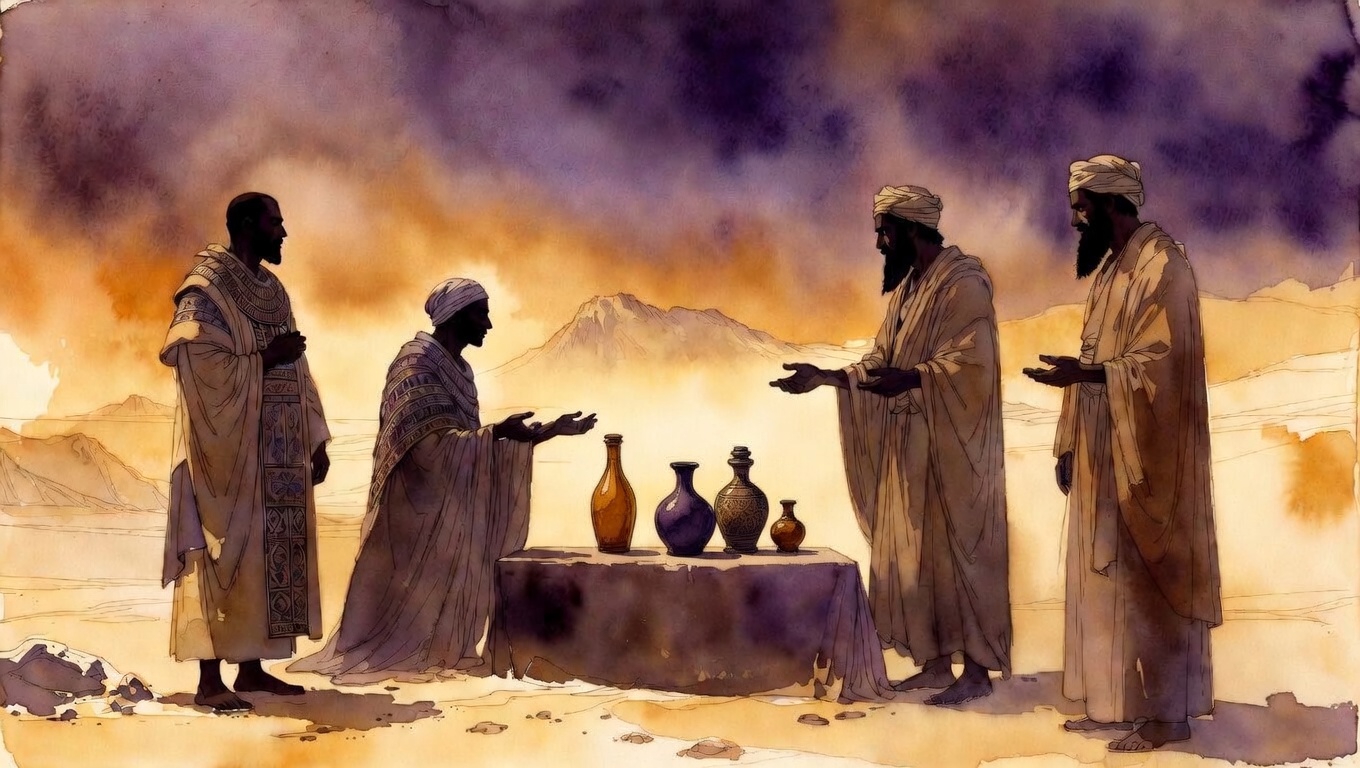
The road was opened not by gold, but by scent.
Entry
Under royal authority, perfumes prepared in Alexandria were presented in exchange for safe passage.
No coin passed
in this exchange.
What was offered
had travelled in vessels.
What was received
was permission to continue.
Materials Presented
Oil compositions bearing lotus and resin.
Preparations of myrrh and cedar.
Aromatic vessels carried sealed,
their contents prepared under the royal perfumer’s supervision.
The materials are named here.
Their proportions
do not belong to this record.
At the Presentation
The Parthian representatives attended to the compositions.
As they examined them,
their speech softened.
I record what could be heard.
What each man thought
was not given to the scribe.
Nor can I divide the value of the scent
from the authority under which it was offered.
Terms of Exchange
Safe passage was granted
through the territories concerned.
No further coin
or material was demanded.
The perfumes were accepted.
The passage was agreed.
These are the terms
preserved in this entry.
Closing Record
The vessels had weight.
The permission they obtained
had none.
Yet without it,
the road could not be taken.
Let the account retain both:
what Alexandria gave,
and what those who received it
allowed to pass.
✧
References
Isidore of Charax, Parthian Stations, §§1–9, translated by Wilfred H. Schoff, 1914.
An overland itinerary through Mesopotamia and Media, naming settlements, royal stations and a customs house. Read the work (opens in a new tab).
Anonymous, Periplus of the Erythraean Sea, §§23–24, translated by Wilfred H. Schoff, 1912.
A first-century CE account describing diplomatic gifts, goods presented to rulers, and fragrant ointments traded at Muza. Read the work (opens in a new tab).
These works provide historical context for routes, aromatic commerce and the presentation of valued goods. The exchange recorded here belongs to the House’s fiction; neither source documents Cleopatra obtaining passage through perfume.