


Ritual Record: The Talisman of the Silver Lotus

1 April 2026 · RITUAL · SYMBOLISM

Status: Recorded, unsanctioned
Authority: Sahir, acting without royal instruction
Prepared by: Unknown source
Provenance: A ritual record within the House’s imagined archive, set in Alexandria in the first century BCE.
House Fragment — Koine Greek
ἀπὸ σκότους φυλάσσει
τὸ λωτοῦ σφράγισμα,
οὐ φανερὸν τοῖς πολλοῖς
ἀλλὰ τῷ φέροντι μόνον.
apo skotous phylassei
to lōtou sphragisma,
ou phaneron tois pollois
alla tō pheronti monon.
The lotus seal guards against darkness,
known not to the many,
but only to its bearer.
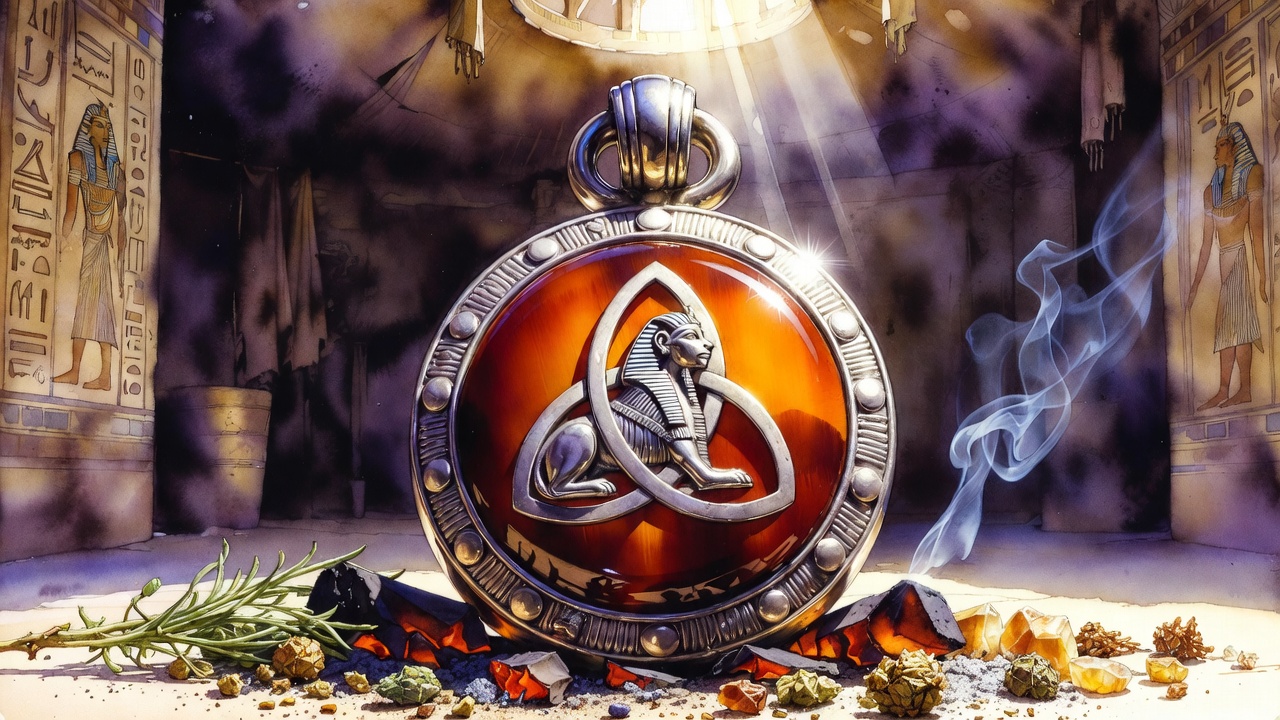
A sealed talisman, prepared without royal instruction.
Record
Sahir prepared the talisman
without commission
and without witness of the court.
The danger was already known.
What she made was neither an offering
nor an ornament intended to be admired.
It was protection
that must pass unnoticed.
Smoke and Boundary
Myrrh and spikenard
rose from coals in a copper vessel.
Their smoke preceded the work.
Beside it, a protective glyph
was traced in powdered kyanite,
marking the boundary
within which the talisman took form.
The record preserves the materials.
The spoken words
remain unentered.
The Sealed Vessel
The talisman was formed of electrum,
its hollow interior holding
a core of carnelian
and a resin prepared for concealment.
The resin is not named.
At the vessel’s mouth,
a miniature sphinx was engraved,
facing outward
across the threshold.
Upon the surface,
three interlocking lotus petals
were traced in silver ash.
The petals joined the intention
to the object that would carry it.
A spoken guard
accompanied the sealing.
Its words were withheld:
their power belonged
to what was kept.
Concealed Adornment
The talisman was made
to rest within an ornament of the hair.
It could be carried close
without announcing its purpose.
Those whose intent it opposed
were not to recognise it.
The outward form belonged to adornment.
What lay within
belonged to protection.
Observation
When the vessel was closed,
a faint resonance remained within it.
Neither heat
nor sound,
but a presence
by which Sahir knew
the seal had taken.
The binding held.
Nothing on the outer surface
declared what had changed.
Closing Record
The talisman was known as
The Silver Lotus.
It had not been commanded
by royal authority.
Sahir had acted
to guard what royal hands
had already marked for harm.
The record keeps her act.
The metal keeps
what she enclosed.
✧
References
The Metropolitan Museum of Art, Wedjat Eye Amulet, object 89.2.416, 664–30 BCE.
A carnelian amulet from Egypt, providing material context for the tradition of protective objects worn or carried by their owners. View the object (opens in a new tab).
Theophrastus, Concerning Odours, §§12–13.
An ancient discussion of aromatic materials and the release of scent through warmth, including myrrh and frankincense. Read the passage (opens in a new tab).
Sahir’s rite, the talisman’s design and its protective powers belong to the House’s fiction. The kyanite boundary, silver-ash marking and concealing resin are imagined ritual elements. These references provide context for amulets and aromatics, not documentation of this rite.