


Ritual Record: The Temple Divination Materials

29 July 2026 · RITUAL · OBSERVATION

Status: Recorded
Authority: A Priestess of Hathor, acting on her own authority
Prepared by: A Priestess of Hathor
Provenance: A ritual inventory within the House’s imagined archive, set in Alexandria in the first century BCE.
House Fragment — Koine Greek
ὁ καπνὸς λέγει
ἃ τὸ στόμα σιωπᾷ.
ho kapnos legei
ha to stoma siōpa.
The smoke speaks
what the mouth leaves unspoken.
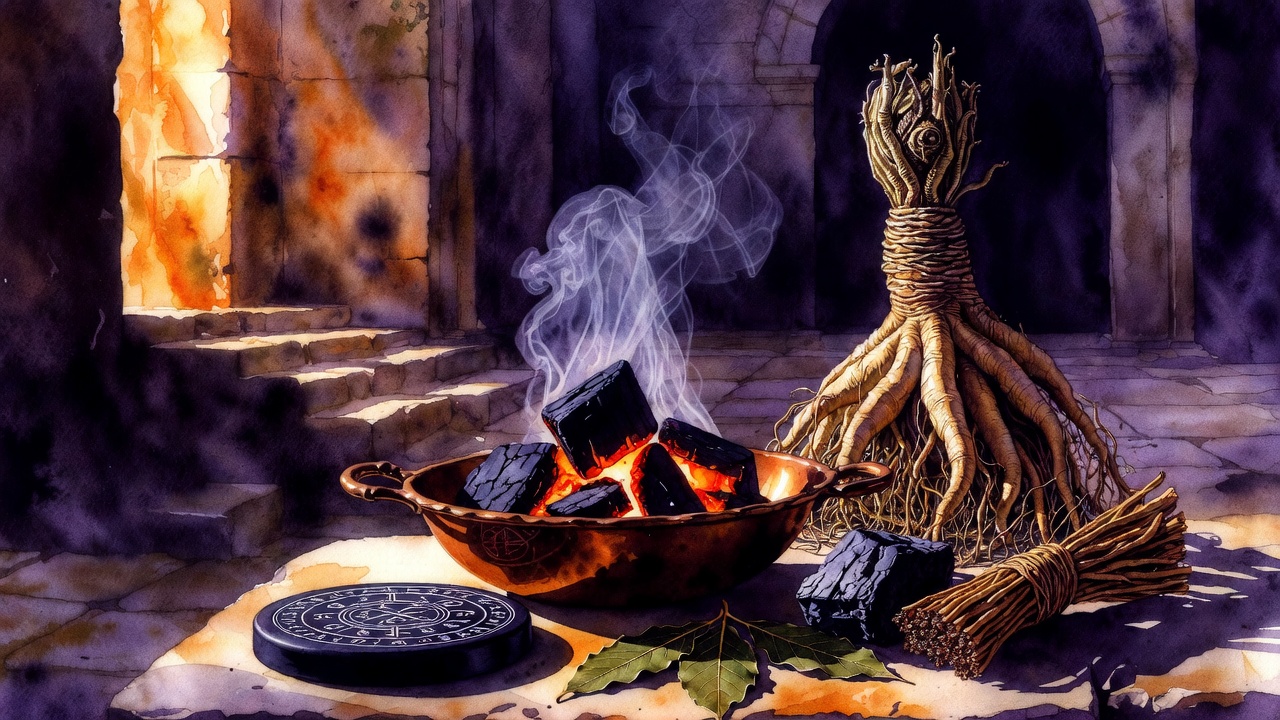
The materials of a rite, its readings withheld.
Record
The account names
the materials of a divination rite
held by a priestess of Hathor.
It does not name
the question brought before her,
nor the answer
she understood herself to receive.
What remains here
is an inventory,
not a reading.
Named Materials
Mandrake root.
Resin of myrrh.
Bark of acacia.
Leaf of bay.
These four materials
were entered together.
Their measures
are not preserved here.
The account describes
an established order of use,
without recording any occasion
on which it was changed.
The Ritual Objects
A copper basin
held the embers.
A disc of black wax
received the traced signs.
The tracing tool
was reserved for this purpose.
Smoke and inscription
belonged to the same rite:
one passing through the air,
the other remaining
upon the wax.
The Reading
Together, the smoke
and the marked disc
were understood by the priestess
to permit perception
beyond what the eye
ordinarily received.
The record preserves
that understanding.
It does not disclose
what she perceived.
Closing Record
The materials were named.
The objects were described.
The reading was withheld.
What the priestess understood
in that hour
was not carried forward
into this account.
The smoke belonged
to the moment of its rising.
The ledger retained
only what had been set beside it.
✧
References
Theophrastus, Concerning Odours, §§12–13.
An ancient discussion of aromatic materials, including myrrh and frankincense used as incense. Read the passage (opens in a new tab).
Royal Botanic Gardens, Kew, “Poisonous plants, pumpkins and the paranormal,” 2016.
A botanical and archival account discussing mandrake’s place in the imagination and identifying it as poisonous. Read the article (opens in a new tab).
The combination of materials, wax-disc practice and divinatory interpretation belong to the House’s fiction, not a documented standard rite of Hathor’s priestesses. Mandrake is poisonous; this manuscript is not a preparation guide, and the described rite should not be recreated.