


Preservation Record: The Sealed Box

29 May 2026 · PRESERVATION · PERFUMERY

Status: Recorded
Authority: Lady Sosandra of Mendes, Keeper of the Fragrant Treasures, acting on her own authority
Prepared by: Unknown
Provenance: A private preservation record within the House’s imagined archive, set in Alexandria in the first century BCE.
House Fragment — Koine Greek
ὃ κρύπτεται ἐν σιωπῇ,
μένει ἀδιάφθορον.
ho kryptetai en siōpē,
menei adiaphthoron.
What is hidden in silence
remains uncorrupted.
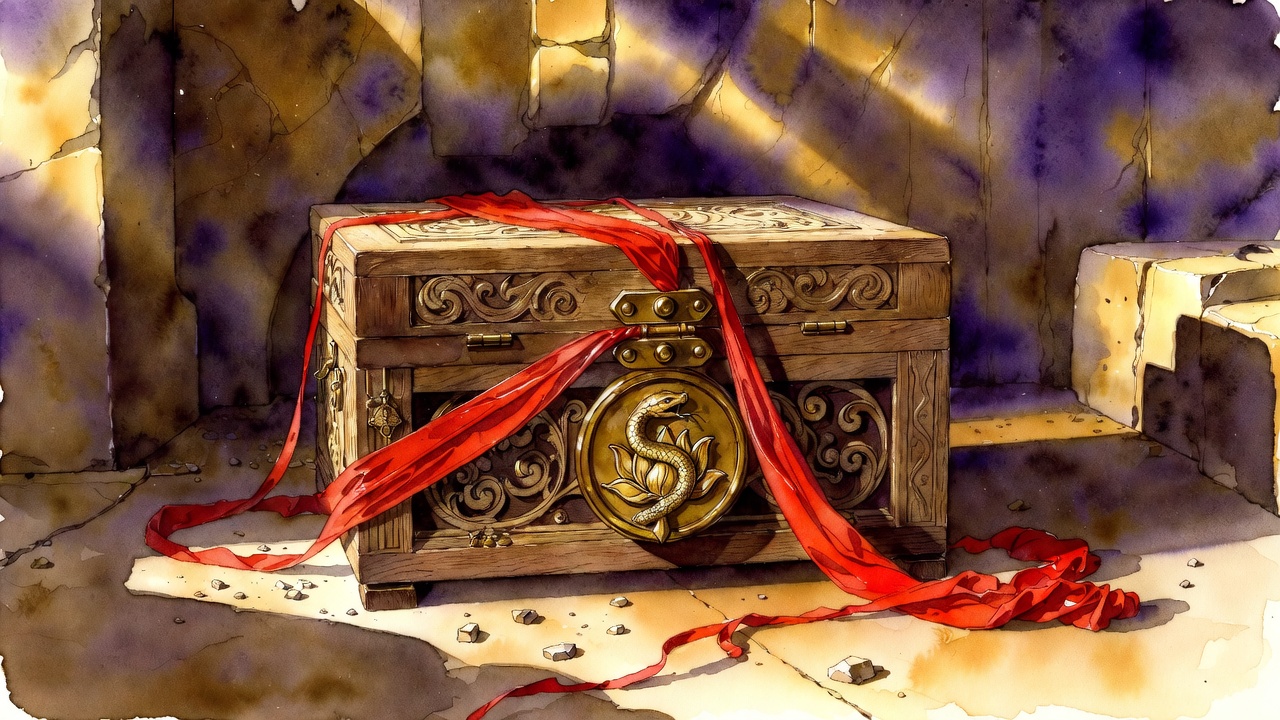
A box lined with fragrance and closed beneath a personal seal.
Record
Lady Sosandra prepared the box
in private.
Its contents were not named.
Neither was the purpose
for which they were to be kept.
The record preserves
what surrounded them:
linen, fragrance,
thread and wax.
The Aromatic Lining
Frankincense
and cedar resin
were named in the treatment
of the linen lining.
A separate cloth pouch
carried vetiver and clove.
It rested beside the contents,
intended to discourage insects
from entering what had been enclosed.
The materials are recorded.
Their measures
are not.
The Binding
Red silk thread
bound the closed box.
Wax covered the clasp,
bearing the impression
of a lotus entwined
with a serpent.
It was Sosandra’s personal sigil.
The mark identified
the hand that had sealed it,
without revealing
what that hand had placed within.
Intended Preservation
The lining and scented pouch
were chosen to protect the contents
against decay
and the intrusion of insects.
The binding held the closure.
The seal marked it.
No date was appointed
for the box to be opened.
Its keeping was intended
to extend beyond
an unnamed span of time.
Observation
The account describes
the resin-treated linen
as retaining its fragrance
longer than expected.
No measured duration
is given.
The wax bore no sign
of disturbance.
What lay beneath it
remained outside the record.
Closing Record
The box was sealed
by one hand
in a single private hour.
Its contents were entrusted
to the preparation around them,
and to the silence
that followed their enclosure.
The record names
the means of keeping.
It does not name
what was kept.
✧
References
Maxime Rageot and colleagues, “Biomolecular analyses enable new insights into ancient Egyptian embalming,” Nature 614, 287–293, 2023.
Analysis of vessels from Saqqara identifies aromatic oils, tars and resins used in embalming and treating wrappings. This provides a distinct historical context for preservation materials. Read the study (opens in a new tab).
The Metropolitan Museum of Art, Seal impression, object 10.130.1556, approximately 1328–1318 BCE.
An Egyptian clay sealing illustrating how impressed seals and cords secured containers and revealed disturbance. View the object (opens in a new tab).
Lady Sosandra’s box and its particular arrangement of materials belong to the House’s fiction. The references do not establish this aromatic lining, vetiver-and-clove pouch, red silk binding or wax sigil as a documented Ptolemaic preservation method, nor guarantee protection against decay or insects.