


Archive Record: The Sanctuary Vault

1 June 2026 · ANCIENT TEXT · ARCHIVE

Status: Recorded
Authority: Cleopatra VII
Prepared by: Lady Sosandra of Mendes, Keeper of the Fragrant Treasures
Provenance: An inventory record within the House’s imagined archive, set in Alexandria in the first century BCE.
House Fragment — Koine Greek
ὅσα κρύπτεται ὑπὸ γῆν,
μένει φυλασσόμενα ὑπὸ τοῦ σκότους.
hosa kryptetai hypo gēn,
menei phylassomena hypo tou skotous.
What is hidden beneath the earth
remains guarded by the darkness.
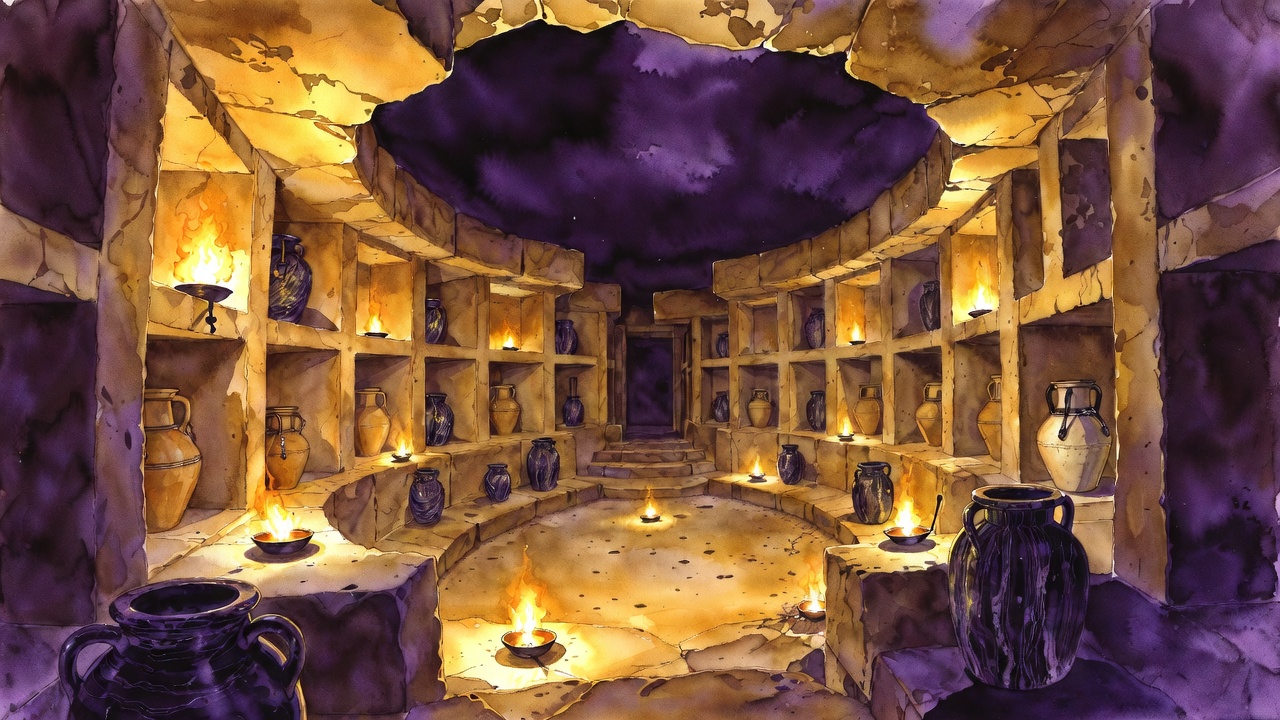
A limestone chamber holding the Sanctuary’s oldest aromatic treasures.
Record
Beneath the ateliers
of the Sanctuary of Scent,
a stair descended
into limestone.
Beyond the reach of daylight
lay a circular chamber,
built to hold
what generations had preserved.
The Chamber
Floral motifs marked the walls,
beside inscriptions
in Koine Greek and Demotic Egyptian.
Oil lamps supplied
the chamber’s only light.
The sun did not enter.
Within the surrounding alcoves,
ceramic ampullae stood
beside vessels of onyx.
Their marks were not ordinary names,
but the private symbols
of the perfumers
who had catalogued them.
Recorded Holdings
Sealed amphorae
carried from Punt.
Pressings of cedar
from Phoenicia.
Essences of blue lotus
attributed to a priestess-queen of Kush.
These were among the holdings
named in the inventory.
Some were recorded
as older than the era of Alexander.
Their attributed age
formed part of the account
kept with them.
Access
Entry was permitted
only under the Keeper’s direct instruction.
No holding was recorded
as leaving the chamber
without that authority.
The vessels were kept
within reach of appointed hands,
but outside
the ordinary movement
of the ateliers.
Observation
The chamber was described
as cool and still
through the changing seasons.
No decline in the stored materials
was noted in the account.
The record gives no method
by which that judgement was made,
nor a measured span
over which it was confirmed.
It preserves the observation
of those entrusted with the holdings.
Closing Record
The vault was not built
for display.
Its alcoves held
the work of keeping:
vessels received,
origins remembered,
fragrances entrusted.
Above it, the ateliers continued.
Below, the older holdings remained,
preserved for continuance
rather than admiration.
✧
References
Theophrastus, Concerning Odours, §§40–41.
Ancient observations on protecting perfumes from heat and sunlight, and on the influence of storage vessels. Read the passage (opens in a new tab).
The Global Egyptian Museum, relief of Hatshepsut’s expedition to Punt, inventory JE 51951.
An earlier Egyptian record of exchange with Punt, including incense and myrrh among the imported materials. View the collection entry (opens in a new tab).
The Sanctuary Vault, its inventory, private symbols and attributed histories belong to the House’s fiction. The references provide context for aromatic trade and storage, not evidence of this chamber or the unchanged survival of its contents.