


Ritual Record: The Rite of the Silver Lotus

13 April 2026 · ROYAL RECORD · RITUAL · SYMBOLISM

Status: Recorded
Authority: Cleopatra VII
Prepared by: Attendants of the Royal Courtyard
Provenance: A courtyard record within the House’s imagined archive, set in Alexandria in the first century BCE.
House Fragment — Koine Greek
πίπτει τὸ πέταλον εἰς ὕδωρ,
καὶ ἠχεῖ ἡ μνήμη τῶν πατέρων.
piptei to petalon eis hydōr,
kai ēchei hē mnēmē tōn paterōn.
The petal falls into the water,
and the memory of the forebears rings out.
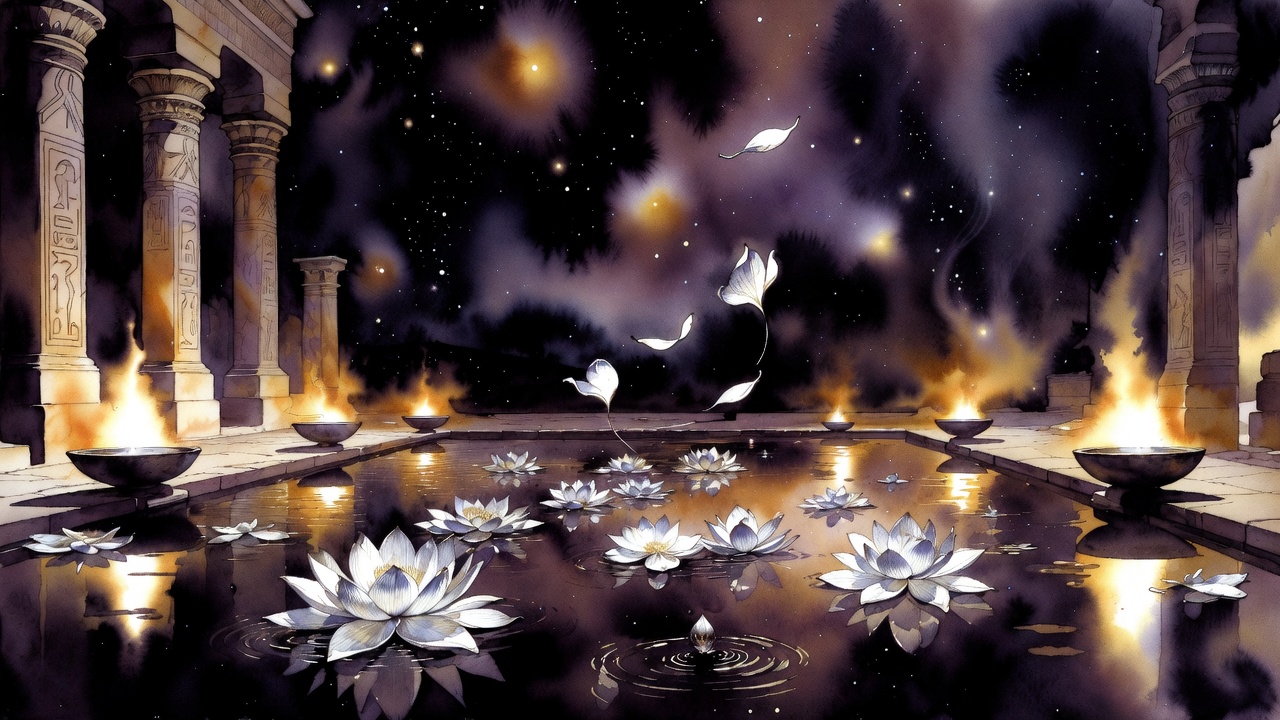
A sacred pool prepared for the casting of petals.
Record
At the turning of the crescent moon,
the royal courtyard received its guests.
Each arriving noble carried
a single lotus petal,
leafed in silver.
The pool lay still.
Around its perimeter,
the braziers were already burning.
The Aromatic Offering
Blue lotus.
Sweet labdanum.
Frankincense.
These were the materials
named in the courtyard record.
Their smoke accompanied the rite
from its beginning to its close,
holding the space around the water
in a shared fragrance.
The composition’s measures
are not entered here.
The Casting
The petals were released
one by one,
without haste.
Each touched the water
and was answered by a chime.
No instrument was seen.
No two sounds
were recorded as the same.
Between one offering and the next,
the water received the silence.
Remembrance
Each chime was understood
as acknowledgement
from the ancestors named in the rite.
The gesture returned
with every petal,
but the remembrance
was not the same.
One offering followed another:
those present answering
those who had gone before.
Observation
The smoke remained
close to the water’s surface.
Its threads did not disperse
or rise beyond the pool
while the rite continued.
Petal, sound and fragrance
held their places
until the ceremony
was complete.
Closing Record
The rite was known as
The Silver Lotus.
It was performed
not for spectacle,
but as a continuance:
one generation’s quiet answer
to those before it.
The petal was released.
The chime was heard.
What had passed
was given a place
among the living.
✧
References
The Metropolitan Museum of Art, Fragmentary Lotiform Chalice, object 30.8.154, Third Intermediate Period.
An earlier Egyptian example of the blue lotus as a symbol of creation and rebirth. View the object (opens in a new tab).
Theophrastus, Concerning Odours, §§12–13.
Ancient observations on aromatic materials and the release of fragrance through warmth, including frankincense. Read the passage (opens in a new tab).
The courtyard ceremony, silver-leaf petals, answering chimes and suspended smoke belong to the House’s fiction. The named incense materials are retained from its narrative, not presented as a documented Ptolemaic blend. These references provide context for lotus symbolism and aromatics.