


Trade Ledger: The Ottoman Perfumer's Vial

15 May 2026 · TRADE · ANCIENT TEXT

Status: Recorded, compiled from later testimony
Authority: Unattributed
Prepared by: House Archivists
Provenance: A compilation within the House’s imagined archive, tracing a vial’s passage from Alexandria to Constantinople, from the close of the eighteenth century into the early twentieth.
House Fragment — French
Ce parfum n'est pas de ce monde.
This perfume is not of this world.
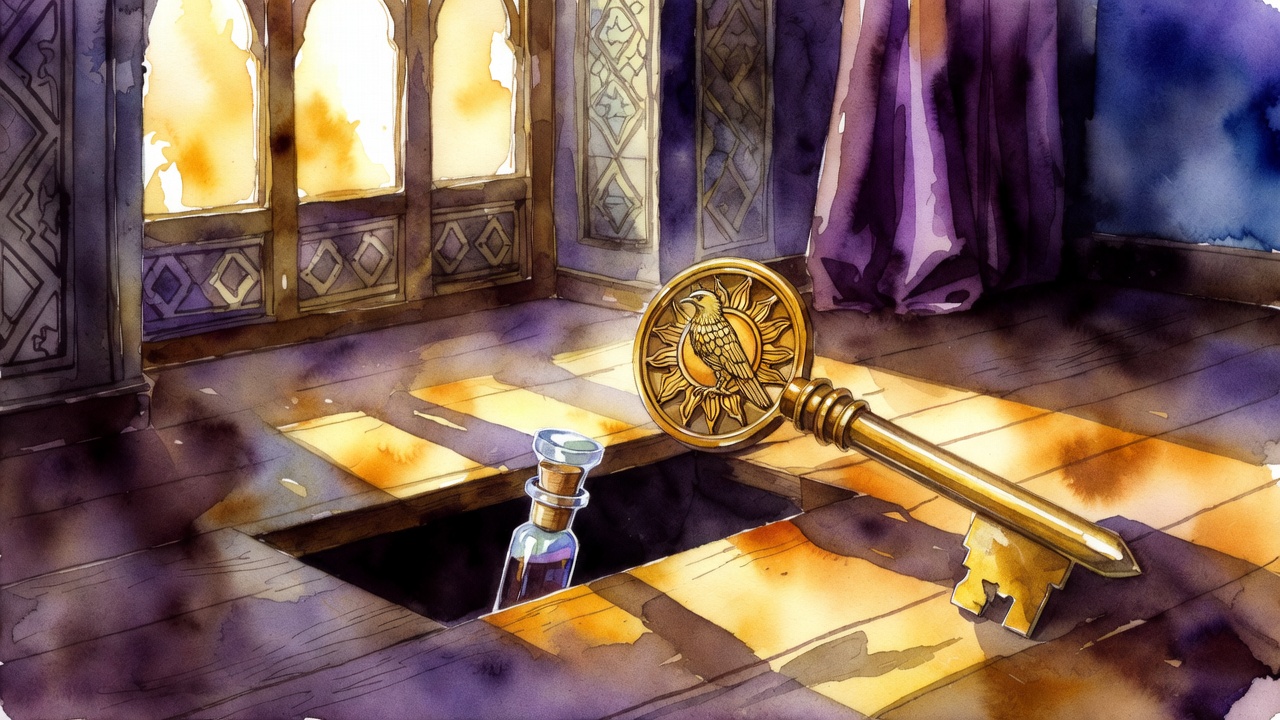
A sealed vial, carried far from where it was found.
Record
The account begins beneath Alexandria,
in a chamber uncovered
at the close of the eighteenth century.
Among what was recovered
was a sealed vial of perfume.
Those who found it
spoke of a scent undimmed
by its passage beneath stone and sand.
The vial remained closed.
How its fragrance was perceived
is not explained in the testimony.
The Passage East
It passed through several hands
before reaching Constantinople.
By then, the account of its finding
had become incomplete.
The vessel endured.
The names of those
who carried it between cities
did not all endure beside it.
Halim Deen
In Constantinople, the vial entered
the keeping of Halim Deen,
a perfumer of established standing.
He recognised it
as more than ornament
and kept it apart
from his working stock.
Within a room of a hotel
favoured by discreet clientele,
it was concealed beneath a floorboard.
Access depended
upon a single marked key.
The Brass Key
The key bore a falcon
crowned by a sun disc,
paired with the image of Isis
in the old manner.
No copy is recorded.
The mark remained
where a name might otherwise
have been placed.
Custodianship
From Halim Deen,
the duty passed to his descendants.
Each received the vial’s keeping.
Not each received
the whole of its history.
Its purpose was not entered
in the ledger,
but the obligation remained:
to preserve what had been entrusted
without requiring every silence
to be answered.
Observation
Across the generations described,
the seal remained unbroken.
Where the scent was mentioned,
it was said to resemble
the fragrance remembered at its finding.
These descriptions belong
to the testimony passed with the vial.
No opening or examination
is recorded.
Closing Record
More than a century
lay between the finding
and the later accounts.
The passage was imperfectly remembered.
The keeping was described
as continuous.
One generation entrusted
to the next
what it had preserved
but could not fully explain.
The vial remained sealed.
The duty passed on.
✧
References
The Metropolitan Museum of Art, Description de l’Égypte, Paris, 1809–1829.
The museum’s account places the recording and transfer of Egyptian antiquities within the context of the French expedition of 1798 and its aftermath. Read the collection entry (opens in a new tab).
Pera Palace Hotel, institutional history.
An example of Constantinople’s late-Ottoman hotel world: the hotel opened in 1895 to accommodate Orient Express passengers. Read the history (opens in a new tab).
The vial, Halim Deen, the marked key and the family’s custodianship belong to the House’s fiction. The references provide historical setting, not evidence of this passage or the perfume’s preservation. The unnamed hotel in the manuscript is not identified as Pera Palace.