


Ritual Record: The Offering to Khonsu

27 August 2026 · RITUAL · ROYAL RECORD

Status: Recorded
Authority: Cleopatra VII
Prepared by: Temple Attendants of Khonsu
Provenance: A temple record within the House’s imagined archive, set in Alexandria in the first century BCE.
House Fragment — Koine Greek
ἡ σελήνη δέχεται
ὅσα ἡ γῆ προσφέρει.
hē selēnē dechetai
hosa hē gē prospherei.
The moon receives
what the earth offers.
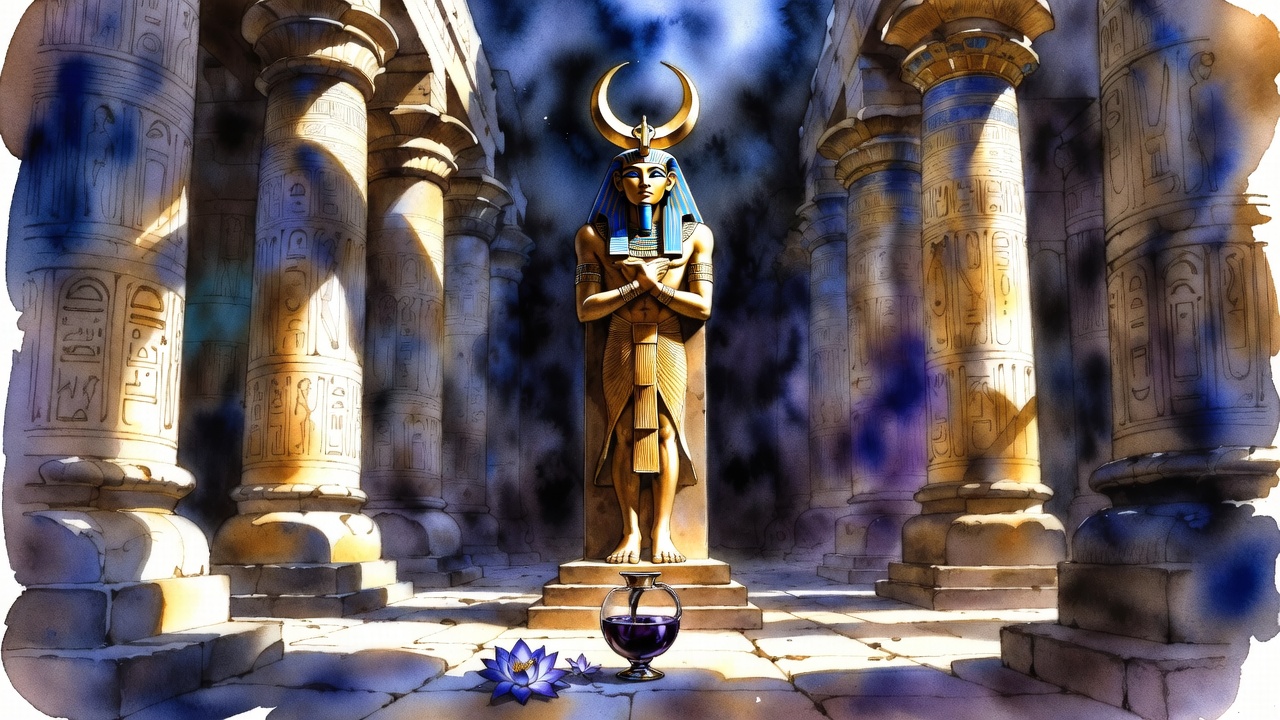
An offering poured beneath the crescent moon.
Record
Beneath the crescent moon,
an offering was made
at the temple of Khonsu.
The attendants recorded
what was brought before the god.
Its purpose
was not disclosed to them.
The Offering
Essence of blue lotus.
Resin of myrrh.
Wine
as dark as the night sky.
The three were brought together
in a single vessel,
then placed
before the statue.
Above it,
the god’s crescent crown
caught the moonlight.
The Silence
The offering was made
in silence.
No accompanying chant
is entered in the account.
Before the rite was complete,
the attendants withdrew,
leaving the one who offered it
alone before the god.
What followed
lay beyond their attendance.
The Morning Record
The following morning,
the vessel was found empty.
Its contents
were entered as received.
The account gives
no further explanation.
The materials are named.
The purpose
remains unrecorded.
Closing Record
Blue lotus,
myrrh
and dark wine.
A vessel
before the crescent-crowned god.
The attendants preserved
what they could witness.
The reason remained
with the one who knelt,
and with the god
to whom the offering
was given.
✧
References
Los Angeles County Museum of Art, Khonsu, Late Period.
A surviving image of the lunar deity. The museum describes his characteristic headdress as a crescent supporting the full moon disk. View the collection record (opens in a new tab).
North Carolina Museum of Art, Royal Offering Scene from a Temple.
A Ptolemaic relief depicting Ptolemy II holding wine jars as offerings, providing context for royal dedication within Egyptian temple imagery. View the relief and commentary (opens in a new tab).
The Alexandrian setting, this combination of materials, the private rite and the empty vessel belong to the House’s fiction. The references provide context for Khonsu’s imagery and royal offerings, not documentation of this particular ceremony.