


Ritual Record: The Incense of Far-Seeing

27 April 2026 · RITUAL · SYMBOLISM

Status: Recorded, unsanctioned
Authority: Sahir, acting without royal instruction
Prepared by: Unknown, from a composition received from an unnamed keeper of old knowledge
Provenance: A private ritual record within the House’s imagined archive, set in Alexandria in the first century BCE.
House Fragment — Koine Greek
ἐν καπνῷ τὸ μακρὰν γίνεται ἐγγύς,
καὶ ὁ νοῦς βλέπει ὃ οὐχ ὁρᾷ ὁ ὀφθαλμός.
en kapnō to makran ginetai engys,
kai ho nous blepei ho ouch hora ho ophthalmos.
In smoke, the far becomes near,
and the mind sees what the eye does not.
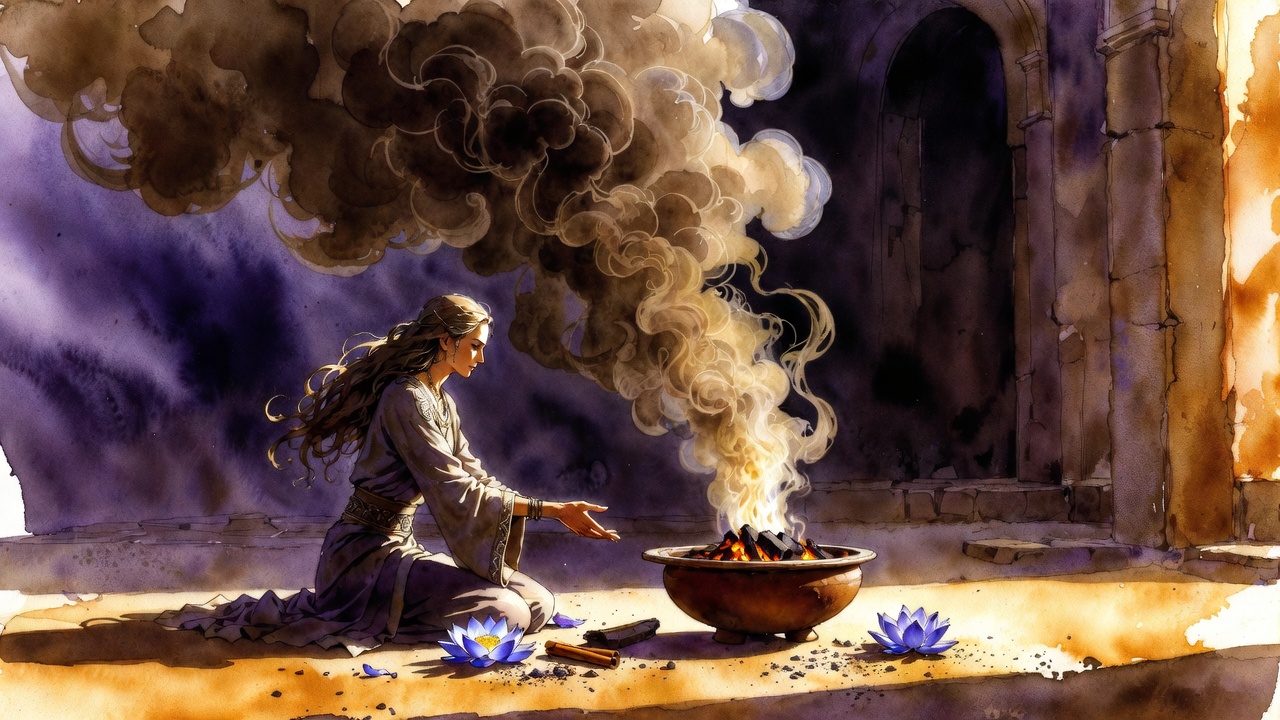
A private incense rite, its composition recorded only in part.
Record
Sahir received the composition
from a keeper whose name
does not appear in the record.
Its earlier passage
was not disclosed.
She prepared and burned it in private,
without royal knowledge.
What was entrusted to her
was greater than what was written down.
Recorded Materials
Cinnamon.
Black resin of myrrh.
Petals of blue lotus.
Flowers of henna.
These are the materials named
within a blend of oils and botanicals.
The oils are not identified.
Neither the full composition
nor its measures
were entered before witnesses.
A clay vessel held the charcoal
on which the incense burned.
The Recitation
Words accompanied the smoke.
They were spoken low
and were not preserved.
The fragrance filled the place
while the smoke gathered,
dense at first,
then loosening
into a form Sahir likened
to a vessel in passage.
The record keeps that likeness.
It does not name
what travelled within it.
Far-Seeing
The incense was understood
to bring distant or obscured matters
within reach of inner sight.
This was the purpose
for which Sahir burned it.
What she perceived
remained her own account.
No second testimony
was entered beside it.
The record does not disclose
the vision in full,
or what meaning
she took from it.
Closing Record
The composition was known as
The Incense of Far-Seeing.
Its materials were recorded
only in part.
Its source remained unnamed.
Its purpose was held
by the one who lit it.
The smoke dispersed.
What had appeared within it
was not given
to the archive.
✧
References
Theophrastus, Concerning Odours, §§27–28.
An ancient account of plant materials used in perfumery, naming cinnamon and myrrh among the ingredients of an “Egyptian” perfume. Read the passage (opens in a new tab).
The Metropolitan Museum of Art, Fragmentary Lotiform Chalice, object 30.8.154, Third Intermediate Period.
An earlier Egyptian example of blue-lotus imagery associated with creation and rebirth. View the object (opens in a new tab).
The composition, its transmission to Sahir and the experience of far-seeing belong to the House’s fiction. The references provide context for aromatic materials and lotus symbolism, not evidence that this blend produces visions or heightened perception.