


Composition Record: The Eternal Throne

18 March 2026 · PERFUMERY · SYMBOLISM · ROYAL RECORD

Status: Recorded
Authority: Cleopatra VII
Prepared by: Tamos, Royal Perfumer
Provenance: A composition record within the House’s imagined archive, set in Alexandria in the first century BCE. It concerns a fragrance commissioned for Cleopatra’s adornment in a ceremonial setting.
House Fragment — Koine Greek
θρόνος
μένει.
thronos
menei.
The throne
remains.
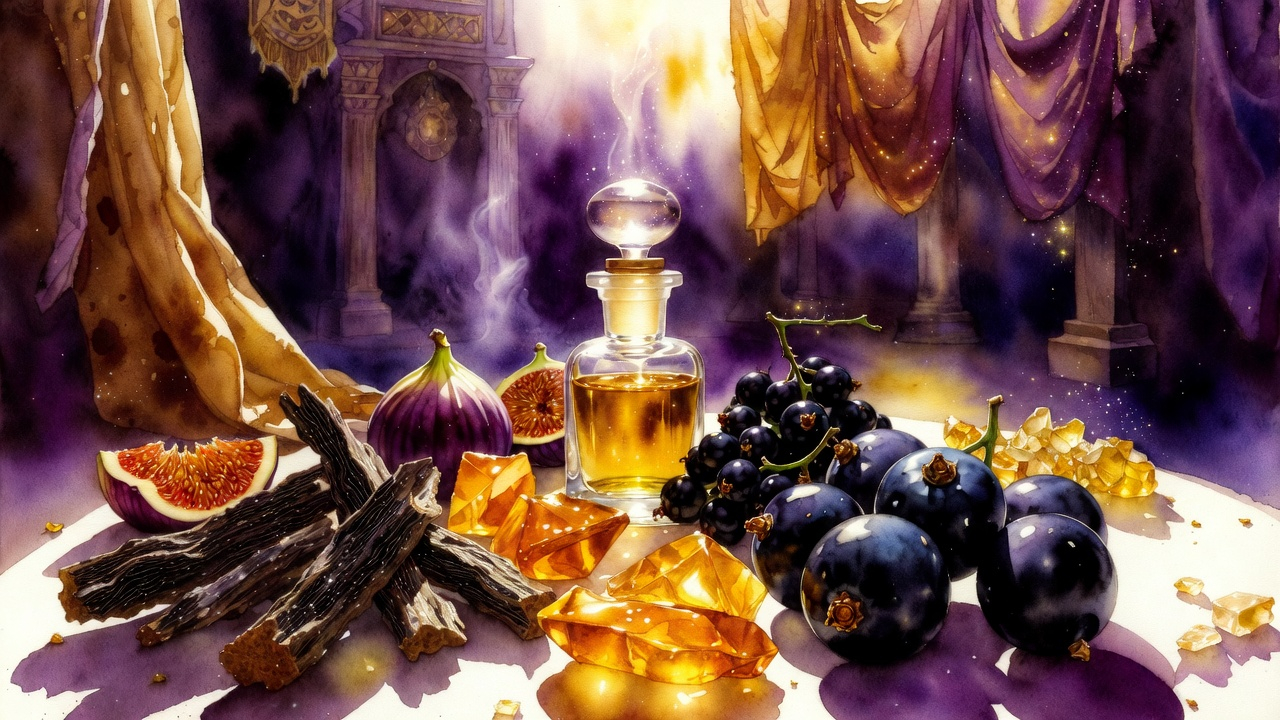
A fragrance intended for sovereign presence.
Record
The Queen’s instruction was for a fragrance to accompany ceremony.
Not a passing brightness.
A presence with depth,
intended to remain perceptible
as the occasion unfolded.
The composition was named
The Eternal Throne.
Its name expressed the commission.
It was not a measure
of how long a scent could last.
Materials and Accords
Bitter orange peel.
Blackcurrant.
Damask rose.
Red wine accord.
Kyphi blend.
White amber accord.
Oud.
Dried fig.
These were the materials and accords named in the House account.
Their quantities
are not entered here.
Intended Character
The opening was conceived with sharpness and weight.
The floral and wine-like character
was to bring fullness.
The deeper materials were chosen
for the presence they could lend,
with dried fig intended
to soften that weight.
No single part
was to stand for the whole.
Observation
The account describes an immediate presence at application and a scent that remained through the period of observation.
The parts were perceived together.
No separation was noted.
These observations belong
to the composition described here.
They do not establish
what every wearing would reveal.
Ceremonial Purpose
The fragrance was intended for application before ceremony.
Its role was to accompany
the Queen’s presence,
and to give olfactory form
to the continuity expressed by the throne.
This was the meaning assigned to it.
Scent did not confer sovereignty.
It accompanied its expression.
Closing Record
The Eternal Throne was prepared
for ceremonial adornment.
Its depth was deliberate.
Its name carried an intention
beyond the duration of its scent.
What the fragrance could accompany
was a moment.
What the commission invoked
was continuity.
✧
References
Plutarch, On Isis and Osiris, §52.
An account of Egyptian incense offerings that includes kyphi at sunset, providing context for its ceremonial associations. Read the passage (opens in a new tab).
Theophrastus, Concerning Odours, §§55–56.
Ancient observations on differences in perfume persistence and changes in scent over time. Read the passage (opens in a new tab).
The commission, ingredient palette and sovereign symbolism belong to the House’s fiction. The accords are expressed in the House’s contemporary fragrance vocabulary, not presented as a documented formula from Cleopatra’s reign. The references provide context for incense and perfume, not evidence of The Eternal Throne.