


Ritual Record: The Donkey's Milk Bath

1 August 2026 · RITUAL · PERFUMERY

Status: Recorded
Authority: Cleopatra VII
Prepared by: Attendants of the Royal Bath Chamber
Provenance: A bathing-chamber record within the House’s imagined archive, set in Alexandria in the first century BCE.
House Fragment — Koine Greek
τὸ γάλα καθαίρει τὸ σῶμα,
τὸ ἔλαιον καθαγιάζει αὐτό.
to gala kathairei to sōma,
to elaion kathagiazei auto.
Milk cleanses the body;
oil consecrates it.
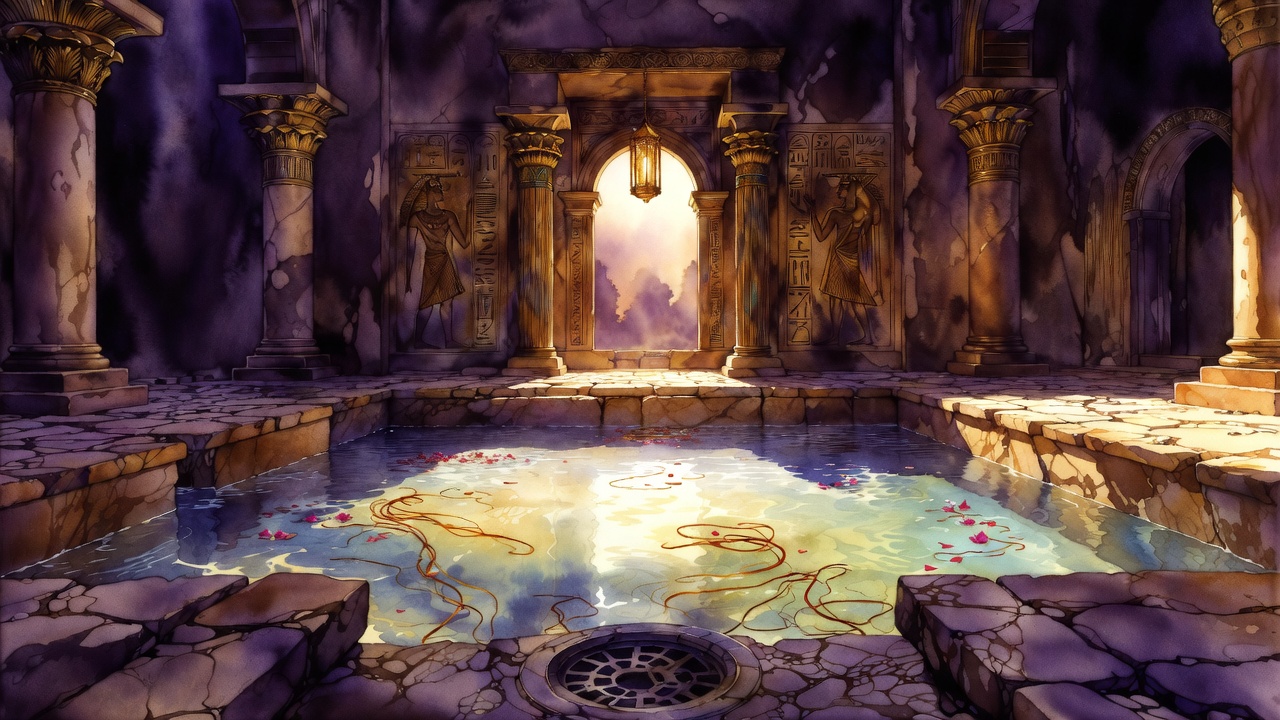
A sunken bath made ready before dawn.
Record
Before dawn,
the attendants make ready
the royal bathing chamber.
The sunken bath
is prepared ahead
of the appointed hour.
Its warmth and fragrance
belong to the quiet work
that precedes
the Queen’s arrival.
Recorded Materials
Donkey’s milk.
Water.
Oil of rose.
Oil of saffron.
These are the materials
named in the chamber’s account.
The milk and water
form the warmed bath.
Rose and saffron
provide its fragrance.
Their measures
are not entered here.
The Attendants’ Care
The attendants check the warmth
before the Queen receives the bath.
The preparation follows
the household’s established practice.
No substitution for the milk
is permitted in the account.
What appears ready
at the appointed hour
requires attention
before it is seen.
Purpose
The bath is intended
for cleansing and softness.
The fragrant oils accompany
that intention,
giving the preparation
its place within
the household’s ritual of care.
The account records
what is sought,
not a measured effect
upon the skin.
Observation
Rose and saffron
remain perceptible
within the chamber
after the attendants
draw the bath away.
The water is gone.
Its fragrance
still lingers in the room.
Closing Record
The preparation repeats
as part of the chamber’s service.
Milk, water and fragrant oils.
Warmth attended to.
The bath made ready.
These are among
the quiet labours
that royalty
simply calls
morning.
✧
References
Pliny the Elder, Natural History, XI.238.
A Roman account describing Poppaea Sabina bathing in donkey’s milk and the cosmetic benefits she attributes to it. The passage concerns Poppaea, not Cleopatra. Read the passage (opens in a new tab).
Theophrastus, Concerning Odours, §27.
An ancient account naming rose and saffron among materials used in perfumery. Read the passage (opens in a new tab).
Cleopatra’s bathing scene, its particular combination of materials and the attendants’ routine belong to the House’s fiction. The references provide context for ancient cosmetic beliefs and perfumery, not documentation of this bath or proof of skin benefits. This is a literary record, not a bathing formula.