


Composition Record: The Empress Fragrance

16 March 2026 · PERFUMERY · SYMBOLISM

Status: Recorded
Authority: Cleopatra VII
Recorded by: Tamos, Perfumer to Cleopatra
Provenance: A composition record within the House’s imagined archive, set in Alexandria in the first century BCE. Attributed to Tamos, working under royal commission in the eastern perfumery chamber.
House Fragment — Koine Greek
ἡ σύνθεσις
ἐκ τάξεως γίνεται,
οὐκ ἐκ μίξεως
μόνον.
hē synthesis
ek taxeōs ginetai,
ouk ek mixeōs
monon.
Composition arises
from order,
not from mixture
alone.
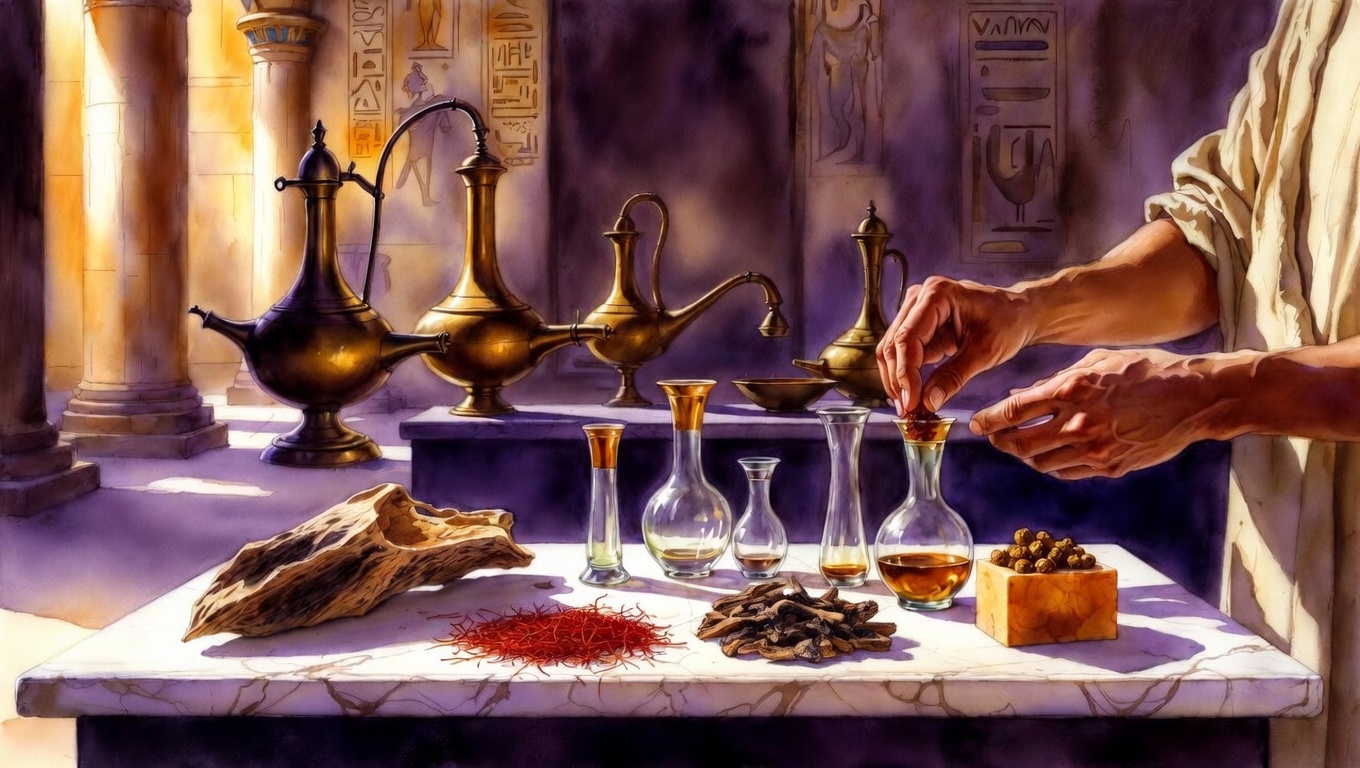
A composition observed over time.
Record
The materials had been selected.
Their presence together
did not complete the work.
I was charged with a composition,
not a gathering of separate scents
within one vessel.
Materials of the Composition
Aged oud.
Myrrh.
Musk.
Saffron prepared in infusion.
Pomegranate derivatives.
Floral distillations.
These were the materials named in the working account.
Their measures
are not entered here.
On Balance
Each material was given a place in relation to the others.
The intention was that none should dominate.
What announced itself first
was not to account for the whole.
Nor was what remained longest
to obscure everything that had preceded it.
This was the balance sought
in the commission.
Observation
The composition was observed as the work progressed.
I did not judge it
by its first impression alone.
Time was allowed
between the work and its assessment.
No adjustment was made without cause.
Each introduction was recorded.
The particulars of that working account
are not reproduced here.
Rest
When the work of combination was complete, the composition was sealed.
It was left without further alteration.
The hand that had introduced the materials
was withdrawn.
Rest belonged to the work.
It was not an absence
of attention.
Closing Record
The composition had been brought together.
It was then left to settle.
This account preserves the care
under which it was made,
not the means
by which it might be repeated.
✧
References
Theophrastus, Concerning Odours, §§37–38.
Ancient observations on variation in aromatic materials and the effects of season, collection and keeping on the perfumer’s work. Read the work (opens in a new tab).
Theophrastus, Concerning Odours, §§55–56.
A discussion of differences in perfume persistence and changes in scent over time, including fragrances described as improving after their initial heaviness diminishes. Read the passage (opens in a new tab).
The commission and Tamos’s account belong to the House’s fiction. These passages provide context for observation and change in perfumery; they do not document the Empress fragrance or establish its formulation.