


Archive Record: The Chronos Root

3 May 2026 · ANCIENT TEXT · PERFUMERY

Status: Recorded, compiled from trade fragments
Authority: Unattributed
Prepared by: House Archivists
Provenance: A compilation within the House’s imagined archive, concerning trade between Alexandria and the Cyrenaican coast in the first century BCE.
House Fragment — Latin
radix rara,
pretio maior auro.
A rare root,
worth more than gold.
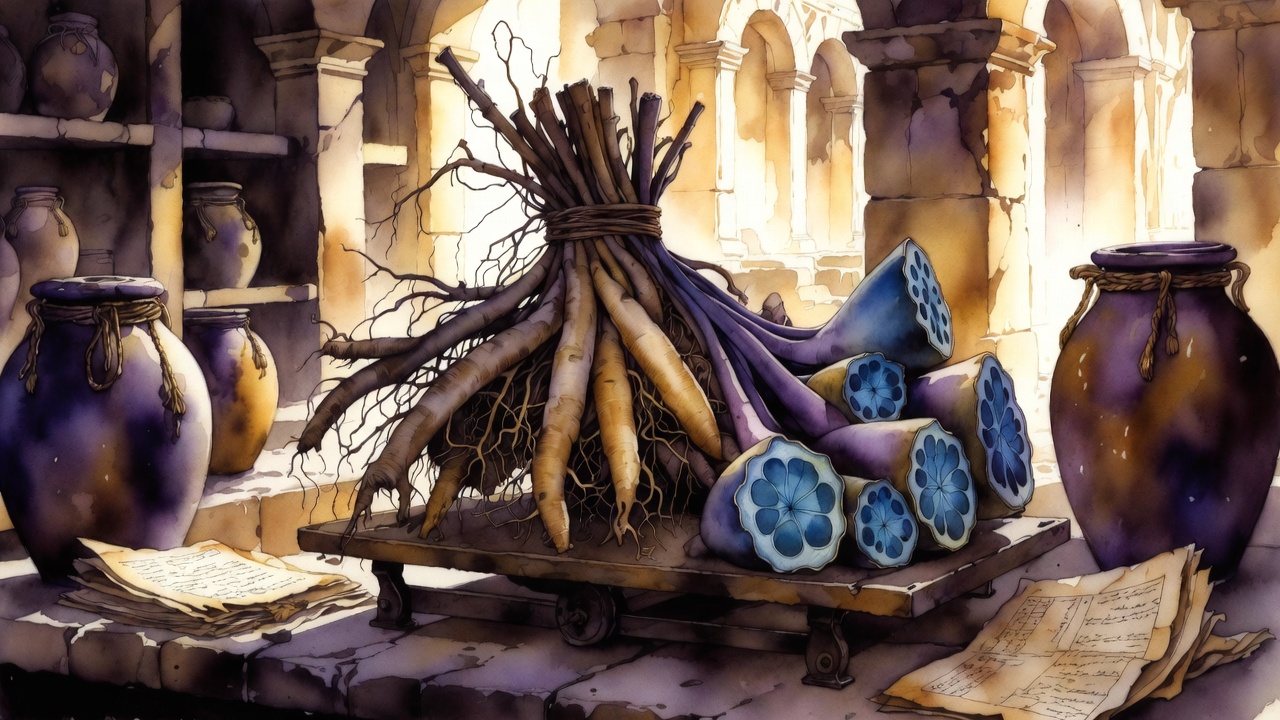
A root traded in fragments, rarely whole.
Record
Among the rare materials
carried along the western routes,
one was known to traders as
The Chronos Root.
Its name appears unevenly
within the House’s trade fragments.
Some entries preserve only a symbol.
Others name the material
without revealing its source.
Origin
The accounts place its origin
on the Cyrenaican coast.
Attempts to transplant it
are remembered as failures.
No successful cultivation elsewhere
is entered in these fragments.
The merchants who carried it
kept the places of gathering
close to their own knowledge.
The root travelled.
The knowledge of where it grew
did not travel as freely.
The Recorded Pairing
Chronos Root.
Blue lotus root
drawn from the Nile.
These are the two materials
named together in the compositions.
Their proportions are not preserved.
The pairing was rarely repeated,
for the availability of the lotus
could not answer
the scarcity of the other root.
Value and Passage
Compositions containing Chronos Root
were described as exceeding
the value of their weight in gold.
Such was the measure
of their rarity in the account.
The material passed
through few hands.
Those who traded in it
disclosed little of its gathering,
and less
of what they believed it held.
What Was Left Unwritten
Properties beyond scent
were spoken of among the traders.
No official ledger
set them down.
The fragments preserve
the existence of the whisper,
not its full meaning.
What was understood
between those who knew the root
remained outside
the written exchange.
Closing Record
The Chronos Root was sought
more often than it could be supplied.
Its name endured
where the material did not.
The archive holds
neither a whole root
nor a complete account,
but the trace of something
whose scarcity outlasted
its passage through the hands of traders.
✧
References
Pliny the Elder, Natural History, Book XIX, chapter 15.
An ancient account of Cyrenaican silphium, its commercial value and its reported scarcity. A historical parallel for rare botanical trade. Read the account (opens in a new tab).
Theophrastus, Concerning Odours, §§27–28.
An account of plant parts used in ancient perfumery, including roots such as iris and spikenard. Read the passage (opens in a new tab).
The Chronos Root, its properties, price and pairing with blue lotus root belong to the House’s fiction. It is not identified here with historical silphium. The references provide context for botanical trade and perfumery, not evidence of this material or composition.