


Ritual Record: The Serapeum Incense Blend

20 March 2026 · RITUAL · PERFUMERY

Status: Recorded
Authority: Temple Commission under Royal Oversight
Recorded by: Lady Sosandra, Keeper of the Fragrant Treasures
Provenance: A ritual record within the House’s imagined archive, set in Alexandria in the first century BCE. Attributed to Lady Sosandra, recording an incense composition prepared in the Serapeum workshop for temple use.
House Fragment — Koine Greek
καπνὸς ἀνίσταται,
φωνὴ ἀκολουθεῖ.
ὀσμὴ ἄγει
ἐκεῖ
ὅπου λόγος οὐ φθάνει.
kapnos anistatai,
phōnē akolouthei.
osmē agei
ekei
hopou logos ou phthanei.
Smoke rises,
a voice follows.
Scent leads
where
words do not reach.
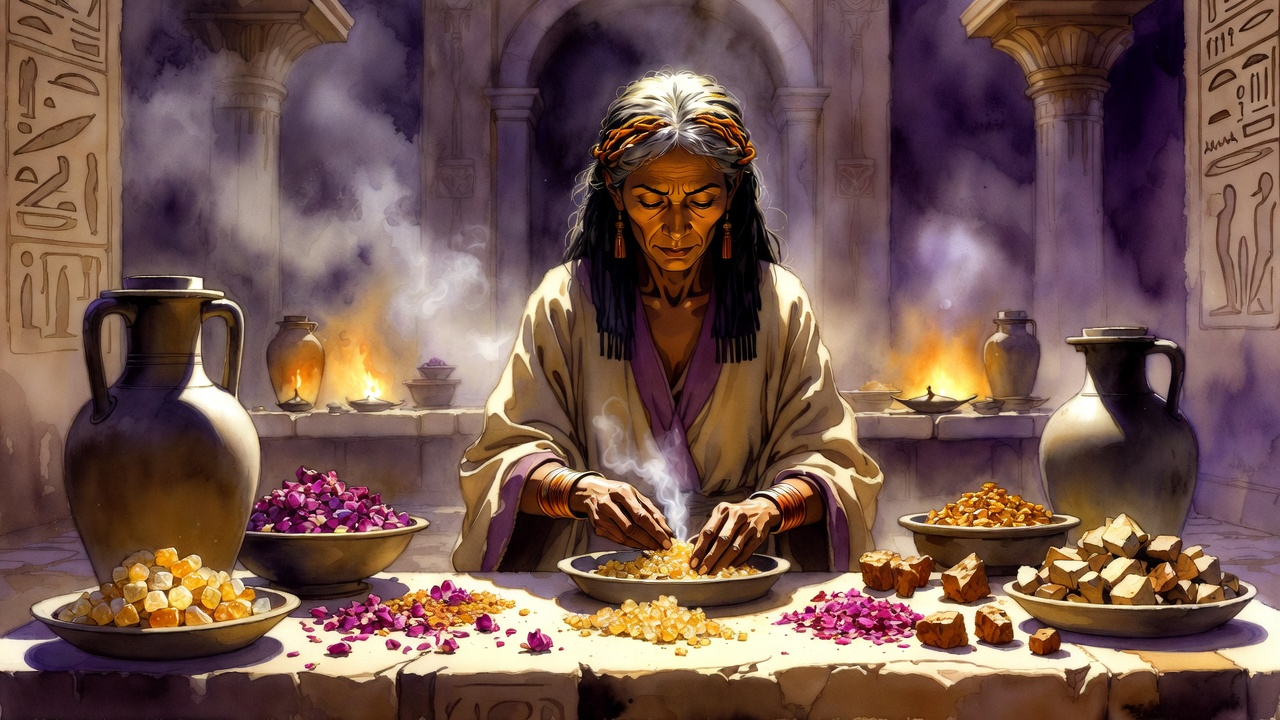
Incense prepared to accompany the temple hymns.
Record
The composition was prepared for the temple.
Not for adornment.
Not for private use.
Its appointed meeting
was with fire.
The fragrance was to move
through the temple space
during the rite.
Materials
Resin selected for the blend.
Dried rose petals.
Myrrh.
Coriander.
Rose water.
These were the materials named in the account.
The rose water served in binding.
Their proportions
are not entered here.
The Commission
The preparation was considered
in relation to its burning.
The commission called for smoke
that would rise and carry scent
through the space of worship.
This was the behaviour sought.
It was not enough
to judge the unburned materials alone.
Observation During the Rite
The smoke rose in a distinct column.
For the period observed,
it held its form
before dispersing.
The scent remained perceptible
while the incense burned.
As the hymns rose,
the smoke rose beside them.
The record joins them
as parts of the same occasion.
On Alteration
The blend was not to be changed
without understanding its behaviour.
What had been observed
belonged to this preparation
and the conditions of its use.
The names of the materials alone
could not preserve that knowledge.
Closing Record
The incense was consumed.
Its fragrance entered the air.
Within the rite,
that passage carried meaning.
What rose was smoke.
What those gathered entrusted to it
was intention.
✧
References
Theophrastus, Concerning Odours, §§12–13.
Ancient observations on the release of scent from aromatic materials, including myrrh and frankincense exposed to heat. Read the work (opens in a new tab).
Plutarch, On Isis and Osiris, §52.
An account of Egyptian incense offerings at different times of day, including resin, myrrh and kyphi. Read the work (opens in a new tab).
The commission, blend and observations belong to the House’s fiction. These references provide context for aromatic burning and ritual incense, not evidence of this particular Serapeum composition or its smoke behaviour.