


Record of Incense Compositions Used During the Festival of Serapis

20 February 2026 · RITUAL · PERFUMERY · OBSERVATION · ANCIENT TEXT

Status: Preserved
Author: Attendant of the Serapeum
Recorded By: Hand of the Inner Court
Provenance: A ritual record within the House’s imagined archive, set at the Serapeum of Alexandria in the late first century BCE.
Fragment — Egyptian, Hieroglyphic Script
𓊹𓌢𓍿𓂋𓈓
snṯr
Incense.
An attested Egyptian word, placed here as an editorial fragment; spelling and meaning follow the Thesaurus Linguae Aegyptiae, entry 138670.
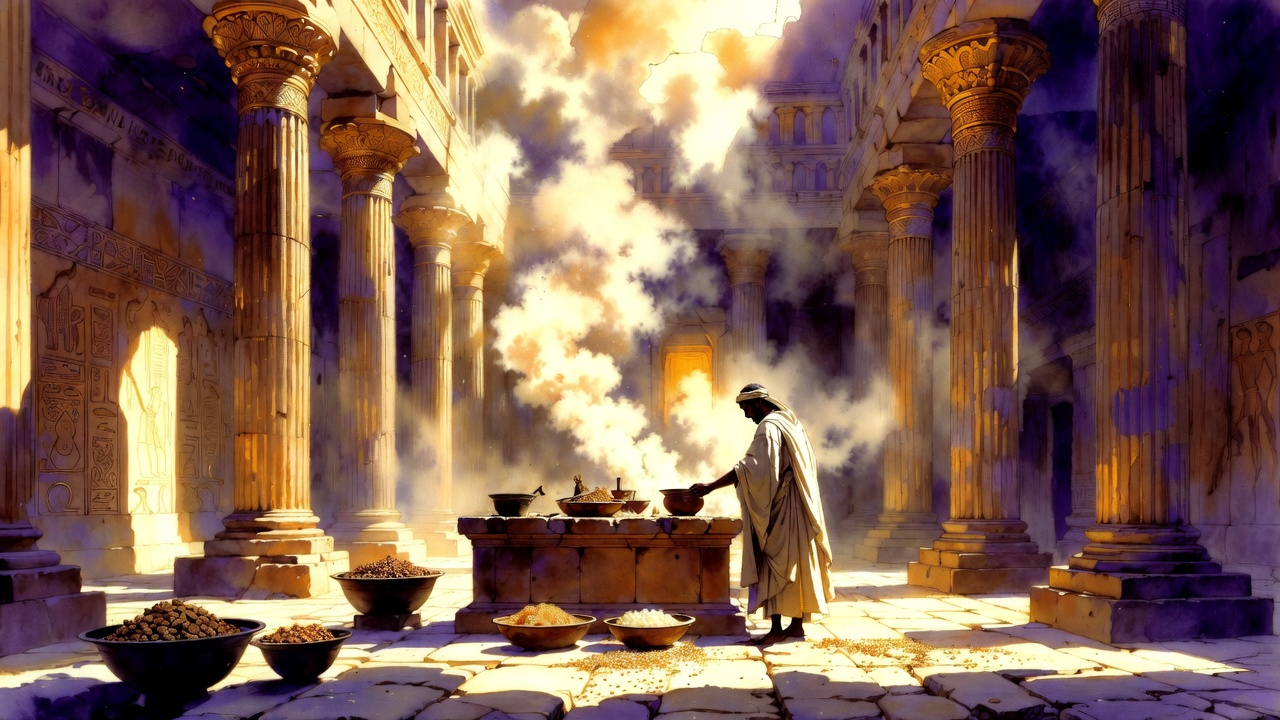
The materials named. The chamber thick with smoke.
Continuation
Frankincense stood first in the record.
Myrrh followed.
Cedar was entered last.
No substitution was recorded.
These were the names retained
for the festival of Serapis.
Their measures are not given here.
Beside the incense stood another entry:
the oils appointed to the altar.
Myrrh, cinnamon, lotus.
The record distinguishes
what was laid upon the surface
from what was given to the fire.
It does not preserve their preparation.
Within the Chamber
The smoke gathered before it rose.
As the burning continued,
the air grew thick.
The account names dizziness
and difficulty drawing breath.
It gives no measure
for how long the attendants remained.
No alteration to the composition
is entered beside these observations.
The difficulty of breathing
and the absence of an amendment
remain together on the page.
The Limit of the Record
The materials can be named.
The smoke cannot be returned
to its separate sources.
Here the entry ends:
with what was burned,
what was laid upon the altar,
and what the chamber held.
✧
References
Strabo, Geography, Book XVII, chapter 1, §10.
The Sarapium within Strabo’s account of Alexandria. A foundation for the setting, not a description of this ceremony. Read the passage (opens in a new tab).
Plutarch, On Isis and Osiris, §52.
A later account of resin, myrrh and kyphi offered to the sun at different hours. It provides context for Egyptian ritual aromatics, not evidence for the sequence imagined here. Read the passage (opens in a new tab).
Berlin-Brandenburg Academy of Sciences and Humanities and Saxon Academy of Sciences and Humanities, Thesaurus Linguae Aegyptiae, entry 138670, “snṯr.”
The hieroglyphic spelling and meaning of the word rendered above as “incense.” Read the entry (opens in a new tab).
The external works provide historical and linguistic context. They do not attest to the particular festival compositions, altar treatment or chamber observations imagined in this House manuscript.