


Perfumery Memorandum Concerning a Reserved Composition Under Royal Instruction

2 February 2026 · archive · perfumery · preservation · ROYAL RECORD

Status: Preserved
Author: Tamos, Servant in Matters of Scent to Cleopatra Philopator
Provenance: Attributed within the House archive to the perfumery chambers of Alexandria, in the reign of Cleopatra VII.
Transmission Note
The preparation was entered in two places.
One record held its making.
The other held the reason
it was permitted to leave the chamber.
This is the second.
The companion ledger remains separately preserved.
Fragment (Earlier Form — Greek)
ἓν ἀγγεῖον ἐσκευάσθη
καὶ ἐσφραγίσθη
οὐ πρὸς κοινὴν χρῆσιν
ἀλλὰ πρὸς χρείαν ὡρισμένην
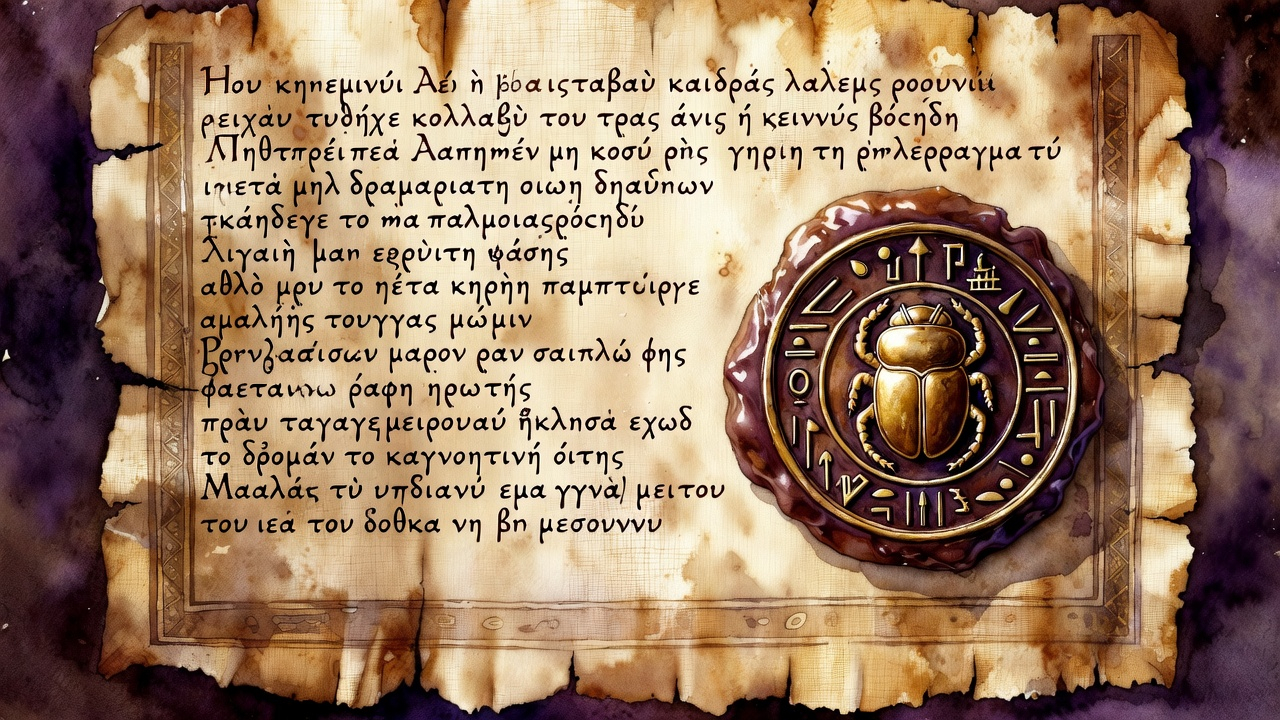
One vessel, withheld from common use.
Continuation
Only one vessel was prepared.
When the wax had settled,
I placed it apart from the others.
There was no instruction
to prepare a second.
The materials belonged to my practice.
Their purpose
had been entrusted to me.
It was not written beside their names.
A woman had arrived in Alexandria.
She gave her name
as Aelia of Nea Paphos.
I had received word of her
before I heard her speak it.
What I had been told
was not mine to repeat.
Only this was required:
that she should not be hindered,
nor questioned,
and that nothing in my approach
should trouble her passage.
The fragrance was to accompany
an ordinary exchange.
A small vessel
carried in the hand.
Nothing in its appearance
declared the instruction
under which it had been made.
On the following morning,
I took it to the Xenodocheion Basilikon.
I carried it myself.
What passed between us
belonged to that meeting.
What left the chamber
belongs to this record.
The ledger retains the preparation.
This leaf retains its departure.
Neither holds the whole.
No further portion was made.
The materials remained within reach.
The permission did not.
Closing Record
The vessel was entrusted
to one encounter.
Its making could be repeated.
The instruction
could not be assumed.
✧
References
Theophrastus, Concerning Odours, §§14–20 and §§37–41.
On the oils that carry fragrance, the joining of aromatic materials, and their preservation. Read the work (opens in a new tab).
Pliny the Elder, Natural History, Book XIII, §§1–26.
On perfumes, their materials, royal associations and the keeping of their fragrance. Read the work (opens in a new tab).
Companion record within the House archive:
Perfumery Ledger Entry: Single-Vessel Preparation of Cardamom and Jasmine Compound. Read the companion manuscript (opens in a new tab).
The external works provide historical context for perfumery. They do not attest to the particular instruction or encounter imagined in this House manuscript.