


Map of the Aromatic Routes

13 January 2026 · archive · trade · ancient text · preservation

Status: Partial
Author: Unattributed Cartographic Hand
Recorded by: Fragmentary Surface Transfer
Provenance: Within the House’s imagined archive, attributed to a reconstructed surface bearing overlapping route markings between southern Arabia, the Levant and Mediterranean exchanges in the late first century BCE.
This record appears not to preserve territory, but passage.
Historical Passage: Koine Greek
δι’ ἧς [ὁδός] ἐστιν εἰς Πέτραν
di’ hēs [hodos] estin eis Petran
through which there is [a road] to Petra
Transmission Note
The passage comes from the Periplus of the Erythraean Sea, §19, describing Leuke Kome and its connection to Petra. The brackets preserve a word supplied by the editor of the Greek text.
This first-century CE source accompanies the map as a later historical reference, not as a transcription of its markings.
What is mapped does not fix place.
Only the passage remains.
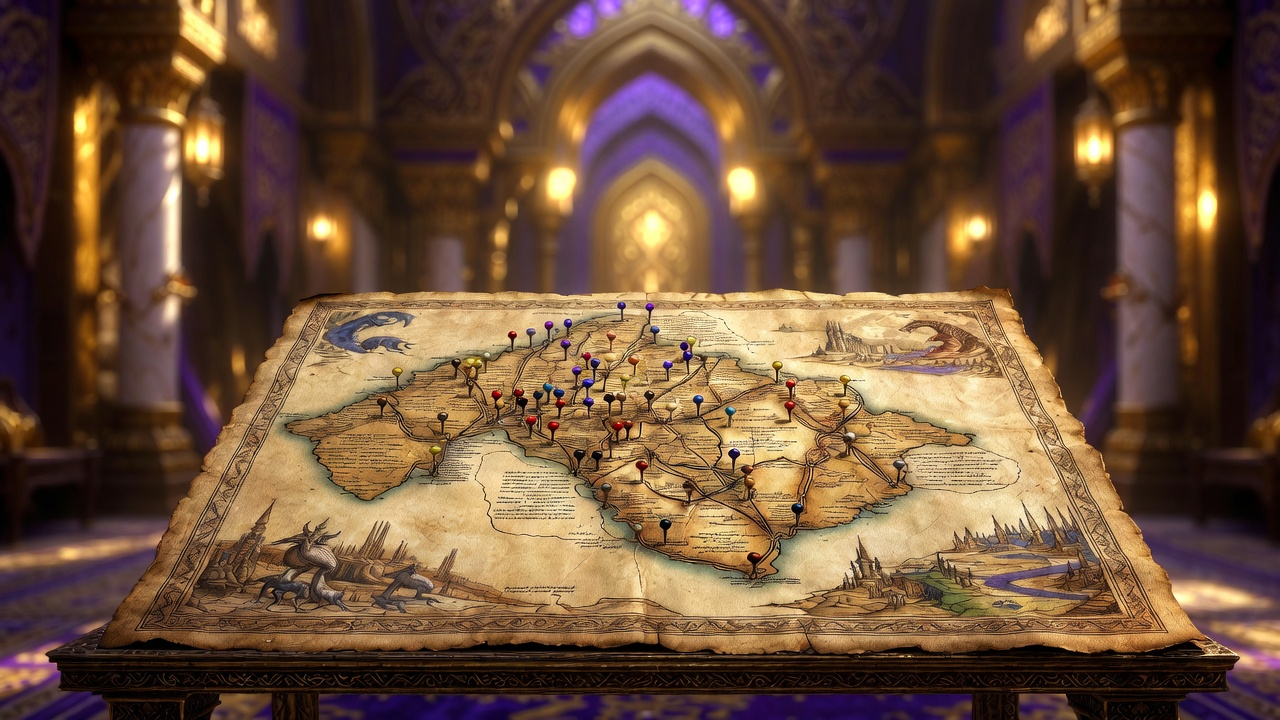
What moved… did not remain where it began.
Continuation
The lines do not meet
at fixed points.
They pass.
Some fade
before completion.
Others return
without origin.
No boundary is held.
Only direction.
It is unclear
whether the markings indicate land
or movement across it.
Certain paths appear
more than once.
Not repetition,
but persistence.
What travelled along them
is not recorded.
Only the trace
of its passing.
It is observed:
that routes carrying similar materials
do not produce the same effect.
Distance alters them.
Climate shifts them.
Time refines them.
What arrives
is not what departed.
And yet,
the path remains.
Not as line.
But as memory.
The map does not conclude.
It disperses.
✧
References
Anonymous, Periplus of the Erythraean Sea, §19.
A description of Leuke Kome and the route connecting it with Petra in Nabataean territory. Read the Greek text (opens in a new tab) or the English translation (opens in a new tab).
UNESCO World Heritage Centre, Incense Route: Desert Cities in the Negev.
Archaeological context for the networks carrying frankincense and myrrh from southern Arabia towards the Mediterranean, including settlements and caravan stations along their course. Read the heritage record (opens in a new tab).
The map, its reconstruction and its observations belong to the House’s fiction. The references establish historical trading connections, not the map’s authenticity. Its language of transformation and refinement is poetic, not a claim that travel or ageing invariably improves aromatic materials.