


Fragment on the Distillation of Floral Waters

21 January 2026 · archive · perfumery · observation · ancient text

Status: Partial
Author: Unattributed Practitioner
Recorded by: Fragmentary Reconstruction
Provenance: Within the House’s imagined archive, attributed to observations of floral extraction transmitted through eastern regions. Its origin and period remain uncertain.
The method is incomplete. The intention is not.
Historical Reference: Arabic Title
كتاب كيمياء العطر والتصعيدات
Kitāb kīmiyāʾ al-ʿiṭr wa-l-taṣʿīdāt
Book of the Chemistry of Perfume and Distillations.
Transmission Note
The Arabic is the title of a historical work attributed to al-Kindi, included as a reference to the perfumery tradition. It is not recovered wording from this fictional fragment.
What is taken is not the whole.
Only what can be released.
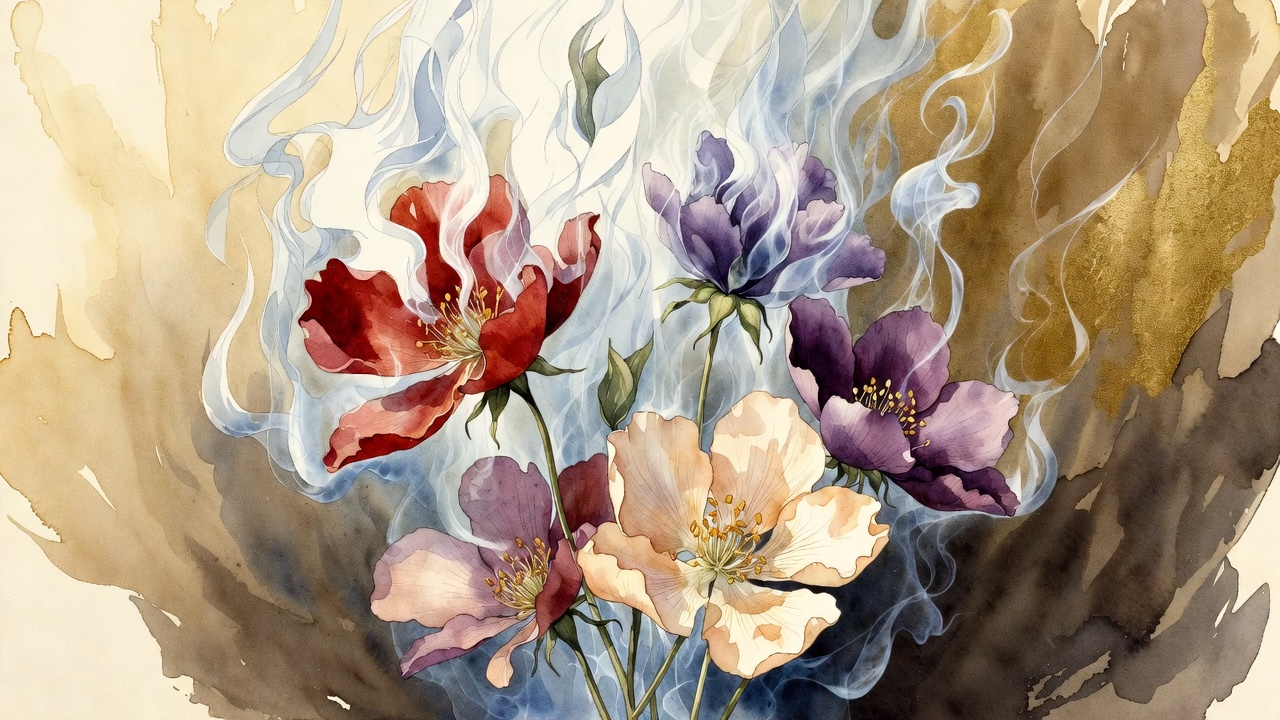
What is drawn… does not belong to the form it left.
Continuation
The flower, when whole,
does not yield all its scent.
It holds something back.
Contained
within its structure.
When pressed,
it resists.
When broken,
it gives only fragments.
This was not sufficient.
It was observed
that under heat,
and in the presence of water,
the flower begins to release
what it does not give freely.
Not all at once.
Not completely.
But gradually.
What emerges
is not the flower.
Nor is it separate from it.
It is something
that cannot remain
within the form.
The water receives it.
Not by holding,
but by carrying.
It was further noted:
that what is drawn
does not resemble
what it came from.
The scent is altered.
Refined.
Made lighter.
And yet,
more pervasive.
The material is reduced.
The essence
is extended.
The process does not preserve.
It transforms.
What is taken
cannot be returned.
And what remains
cannot be restored.
✧
References
Al-Kindi, Kitāb kīmiyāʾ al-ʿiṭr wa-l-taṣʿīdāt.
A historical work on perfume and distillation associated with the ninth-century Arabic tradition. Karl Garbers’s 1948 edition is catalogued by the Wellcome Collection (opens in a new tab); the Arabic title is also recorded by the National Library of Israel (opens in a new tab).
This fragment belongs to the House’s fiction. Its language of release and transformation is poetic, not a complete distillation method or a claim that every flower responds alike. The historical reference does not establish the fragment’s date or provenance.