


Trade Record: The Eastern Route of Aromatics

6 March 2026 · TRADE · PERFUMERY · ARCHIVE

Status: Recorded
Authority: Cleopatra VII
Recorded by: Royal Scribe of the Eastern Expedition
Provenance: A trade record within the House’s imagined archive, set in Alexandria in the first century BCE following the return of Cleopatra VII’s eastern expedition. It gathers the route, materials and exchanges into an account retained by the Crown.
House Fragment — Koine Greek
ἀπὸ θαλάσσης
εἰς γῆν,
ὀσμὴ μεταφέρεται
διὰ ἐθνῶν.
apo thalassēs
eis gēn,
osmē metapheretai
dia ethnōn.
From sea
to land,
scent is carried
through nations.
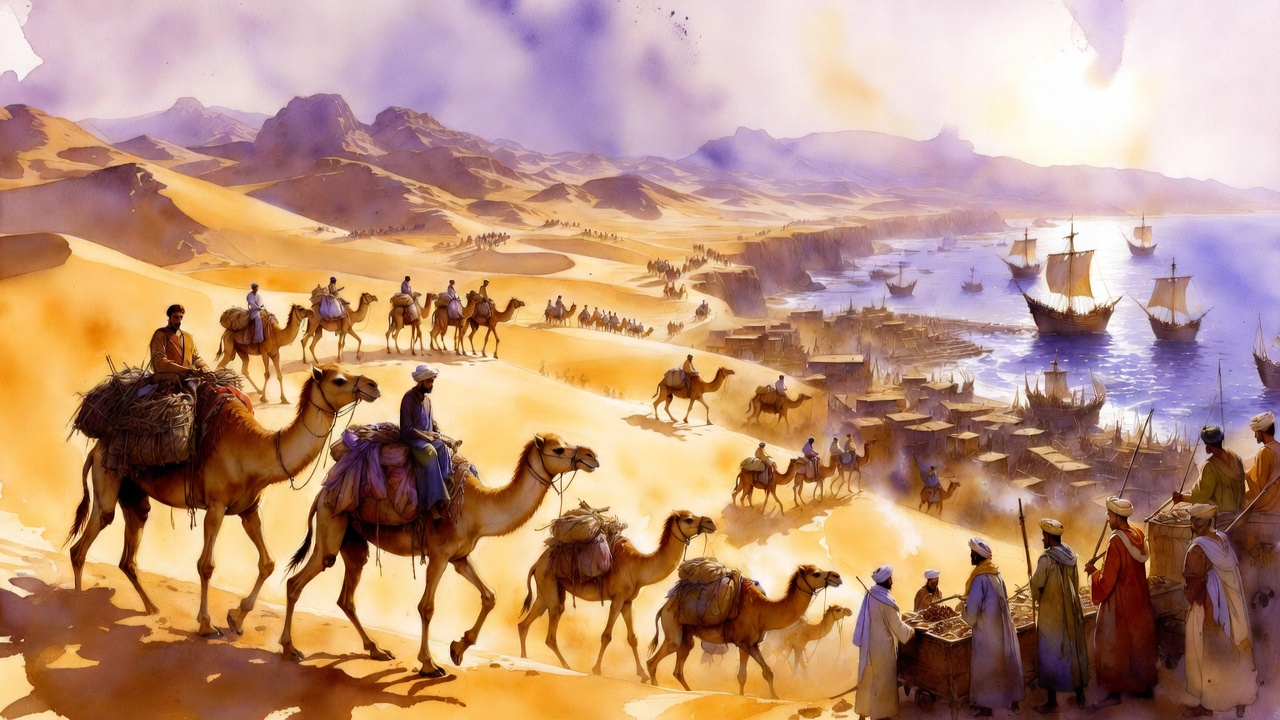
Movement of scent across sea and land.
Record
The expedition returned with aromatic materials acquired across sea and land.
Their names were entered.
So too were the places of exchange.
A material might be received at a port
far from the ground that bore it.
The place of purchase
was not always its place of origin.
Route
From Alexandria, the expedition proceeded to Berenice Troglodytica on the Red Sea.
From Berenice, the voyage continued towards the Arabian coast and the southern ports engaged in the resin trade.
The eastern passage joined sea travel
to an overland journey through Persian territories,
and continued
into Arachosia.
The route is retained here
as the course of the expedition.
It does not contain every journey
made by the goods before they reached us.
Materials Received
Myrrh.
Frankincense.
Saffron.
Sandalwood.
Other aromatic resins received along the route.
These were entered among the materials acquired through exchange.
Papyrus, Alexandrian glass, textiles and medicinal preparations also belonged to the exchanges recorded.
Not every article carried
was itself a source of scent.
Some formed part
of what made its acquisition possible.
Terms of Exchange
The acquisitions entered in this account were negotiated.
No material was recorded as taken
without agreement.
Relations depended upon attention
to the customs, languages and religious practices
of those with whom the expedition dealt.
The Crown’s authority travelled with its representatives.
It did not make every place
an extension of Alexandria.
Observations on the Materials
The resins received differed in colour, density and strength of scent.
Among the portions examined, the southern Arabian frankincense opened more sharply than the preparations familiar in Egypt.
The myrrh carried a heavier character.
Saffron was encountered
both unprepared and prepared,
with differences in intensity.
These observations belong
to the materials received.
They are not a judgment
upon every harvest of a land.
Methods of use also differed.
Some materials were burned.
Others were infused
or kept in oil.
The name of an aromatic
did not tell us all that was done with it.
Closing Record
Alexandria received the materials.
The record was to retain
something of their passage.
Where they were exchanged.
How they were encountered.
What was observed.
The scent could enter a new composition.
The knowledge of its journey
was not to be discarded with its wrapping.
✧
References
Anonymous, Periplus of the Erythraean Sea, §§1, 24, 27 and 36, translated by Wilfred H. Schoff, 1912.
A first-century CE account naming Berenice among Egypt’s maritime ports and describing trade in saffron, myrrh, frankincense and sandalwood through Arabian and Persian Gulf markets. Read the work (opens in a new tab).
Isidore of Charax, Parthian Stations, §§15–19, translated by Wilfred H. Schoff, 1914.
An overland itinerary through eastern territories, ending with Arachosia and its metropolis, Alexandropolis. Read the work (opens in a new tab).
These works provide historical context for connected routes and aromatic commerce. The expedition, its acquisitions and its observations belong to the House’s fiction; the sources do not document Cleopatra undertaking this journey.