


Composition Record: Daughter of the Dawn

25 March 2026 · PERFUMERY · SYMBOLISM · ROYAL RECORD

Status: Recorded
Authority: Cleopatra VII
Prepared by: Tamos, Royal Perfumer
Provenance: A composition record within the House’s imagined archive, set in Alexandria in the first century BCE. It concerns a fragrance commissioned for the adornment of Selene, daughter of the Queen.
House Fragment — Koine Greek
ἐκ φωτὸς ἀνατέλλει
καὶ ὀσμὴ φανεροῦται,
οὐκ ἄνευ σκοποῦ
ἀλλὰ διὰ τάξεως.
ek phōtos anatellei
kai osmē phaneroutai,
ouk aneu skopou
alla dia taxeōs.
It rises from light
and scent is revealed,
not without purpose,
but through order.
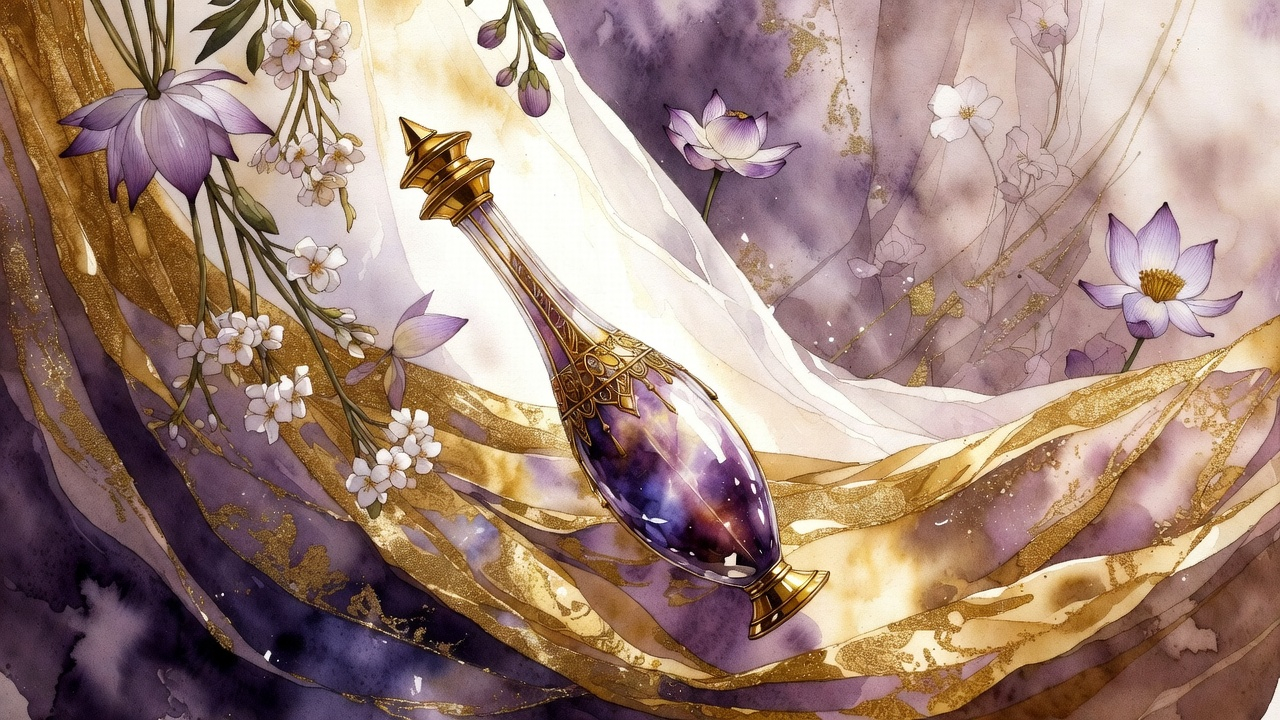
A fragrance commissioned for Selene.
Record
The composition was prepared for Selene’s adornment under the Queen’s authority.
It was named
Daughter of the Dawn.
The commission called for brightness
that would open into depth,
and for a fragrance whose unfolding
could suggest emergence and continuity.
These were the meanings assigned to it.
Materials and Accords
Green mandarin.
Silver lotus accord.
Neroli blossom.
Egyptian jasmine.
Honey-treated myrrh.
White sandalwood.
These were the materials and accords named in the House account.
Their measures
are not entered here.
Intended Character
The mandarin was chosen for the brightness of the opening.
The silver lotus accord
was conceived as a reflective floral presence,
joined by neroli blossom
and Egyptian jasmine.
Honey-treated myrrh was intended
to bring resinous depth with softened bitterness.
White sandalwood
was to carry that depth onward.
The intention was a passage
from brightness to stillness,
without the fragrance seeming
to break into separate parts.
Observation
The account describes a clear opening, a gradual transition and a deeper scent that remained through the period observed.
No instability was noted.
These observations concern
the composition recorded here.
They are not a promise
of identical behaviour upon every skin.
Purpose of the Commission
The fragrance was intended to be worn within a ceremonial setting.
Its association with lineage
belonged to the royal commission.
The scent could accompany Selene’s presence.
It did not establish
who she was.
Closing Record
Daughter of the Dawn was prepared
as an adornment with an assigned meaning.
Brightness was its beginning.
Depth was intended to remain.
The name joined them
within the thought of dawn:
not light alone,
but what begins
to become visible.
✧
References
Anonymous, Periplus of the Erythraean Sea, §36, translated by Wilfred H. Schoff, 1912.
A first-century CE account naming sandalwood among goods carried from Barygaza to Persian Gulf ports. Read the work (opens in a new tab).
Theophrastus, Concerning Odours, §§55–56.
Ancient observations on differences in perfume persistence and changes in scent over time. Read the passage (opens in a new tab).
The commission, ingredient palette and symbolism belong to the House’s fiction. Names such as silver lotus accord and neroli belong to its contemporary fragrance vocabulary, not a documented recipe from Cleopatra’s reign. The references provide context for material trade and perfume, not evidence of Daughter of the Dawn.